
About
I am deeply drawn to the human form. In one way or another, the human presence finds its place in every work I create. Whatever captures my interest—consciously or unconsciously—shapes and enriches my art with my personal imprint. My creative journey is guided by emotion and thought, expressing my inner concerns and questions.
Each artwork opens a small window into the inner world, revealing what has always been there: the invisible, the unspoken, the space between dreams and fears, memories and expectations. My images move within the contrasts that define us: beauty alongside decay, love beside loss, light in conversation with darkness. In this delicate balance, the true journey begins — a transition that shows how even decay can hold beauty, how loss leaves memory, and how dreams can spark hope even in difficult moments.
Exhibition
Through this approach, my work aims to create a space of dialogue with the viewer — a place where the visible meets the invisible, and where each piece becomes a bridge between the inner world and the broader human experience.
CV available here
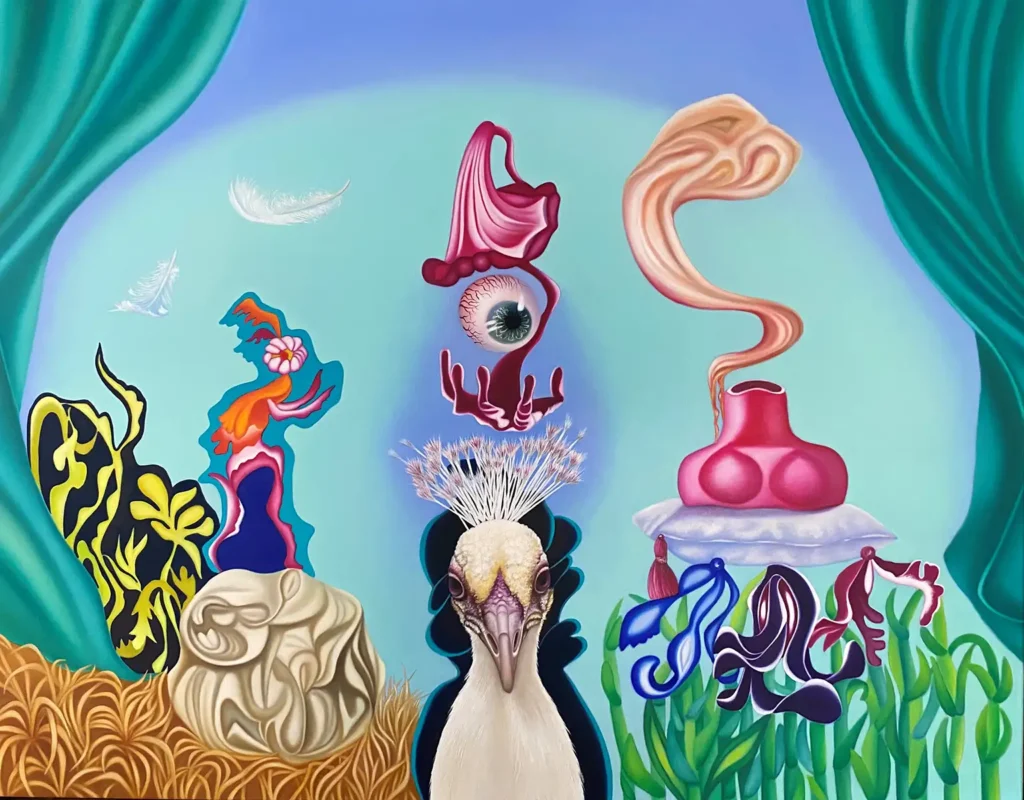
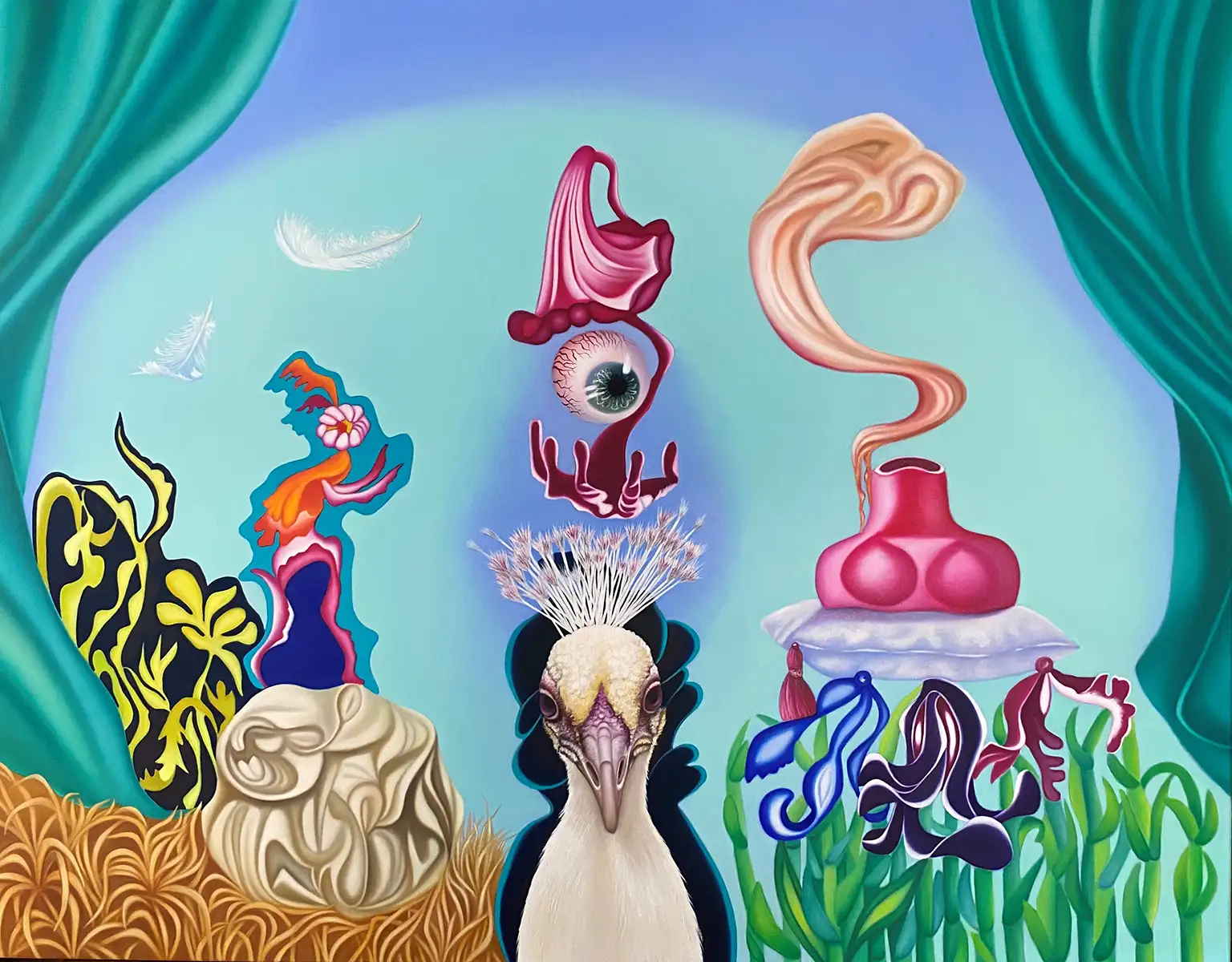
The Theatre of the Timeless Self (2025)
Curatorial Statement
Zoe Kalfa, Art Historian
The Theatre of the Timeless Self proposes a visual environment in which the subject is reconstituted beyond historical, biological, and social time. It is a stage of transformation—an intermediate realm where the viewer is invited to reflect on the nature of identity, the body, and the gaze within a symbolic, hybrid universe.
At the center stands a gaze—that of a peacock—serene yet piercing. The choice of the peacock, with its manifold symbolic resonances, alludes both to the psychoanalytic function of the gaze (Lacan, 1977) and to a primordial notion of vigilance, empathy, and witnessing. The blue-black petals that frame the eye operate as “psychic landscapes”—mnemonic imprints without clear biological origin. Within this framework, nature ceases to be organic and is rendered cognitive, endowed with intelligence and subjectivity (Haraway, 1991).
The open palm, hovering above the gaze, carries a dual meaning: it can be read either as a gesture of protection or one of revelation. The red ribbon connecting it to an inverted lily evokes an umbilical cord—suggesting a symbolic birth, not biological but metaphysical or cultural. The downward-facing flower, directed toward the earth, overturns the traditional iconography of ascension toward light and instead implies introspection—a search for origins rather than fulfillment (Kristeva, 1982).
The headless bust resting on a cushion embodies the deconstruction of traditional identity. The absence of the head—historically associated both with loss of control and liberation from the dominance of reason—can also be read as a gesture of detachment from logic and individuality (Butler, 1990). The body here is not an instrument of identification but a field of possibilities; the cushion that supports it denotes an in-between space—a place of waiting, rebirth, or submission.
Matter flows around this form—matter in a state of transition. Fluidity here incarnates transformation, in the Deleuzian sense of a becoming-form that never stabilizes but remains in perpetual motion (Deleuze & Guattari, 1980). From the shadow of the missing face emerges a new kind of presence—without fixed identity or gender.
Within this same landscape, inverted flowers turn toward the ground instead of the sky. They no longer seek light as destiny but root as origin—an act of reversal against teleological thinking. Green tubes, organic or not, function as roots or veins, suggesting the constitution of a new life-form—perhaps techno-organic, as imagined by posthumanist philosophy (Braidotti, 2013).
The pouch and the humanoid figure made of petals are imagined forms—creatures not born of biology but of art’s capacity to represent what has not yet come into being. Floating feathers serve as symbols of lightness—perhaps of memory, perhaps of liberation from the weight of identity.
Ultimately, the work constitutes a theatre of the soul: a visual intermediary space where the boundaries of gender, body, time, and gravity dissolve. In this sense, utopia is not conceived as perfection or a future destination, but as a potential for continuous metamorphosis—a state already latent within forms, shadows, and gestures that carry intent (Muñoz, 2009). The bodies here are not static but fluid; not entirely material, but messengers of a future in the making.