Symbol of freedom
130x90cm, oil on canvas
After Franz Xaver Winterhalter, 1863. An organ of vision becomes a substitute for the face. The two “threads” connecting the eye to the garment act as vulnerable conduits—fibrous filaments between body and inner truth, a fragile bridge between social and psychic reality. The work ironically raises questions: what does freedom truly mean when we are bound by sartorial roles, imposed identities, and expectations? Reviving Winterhalter’s style, I do not long for the past, but rather use it as a springboard explore the existential voids and anxieties of today.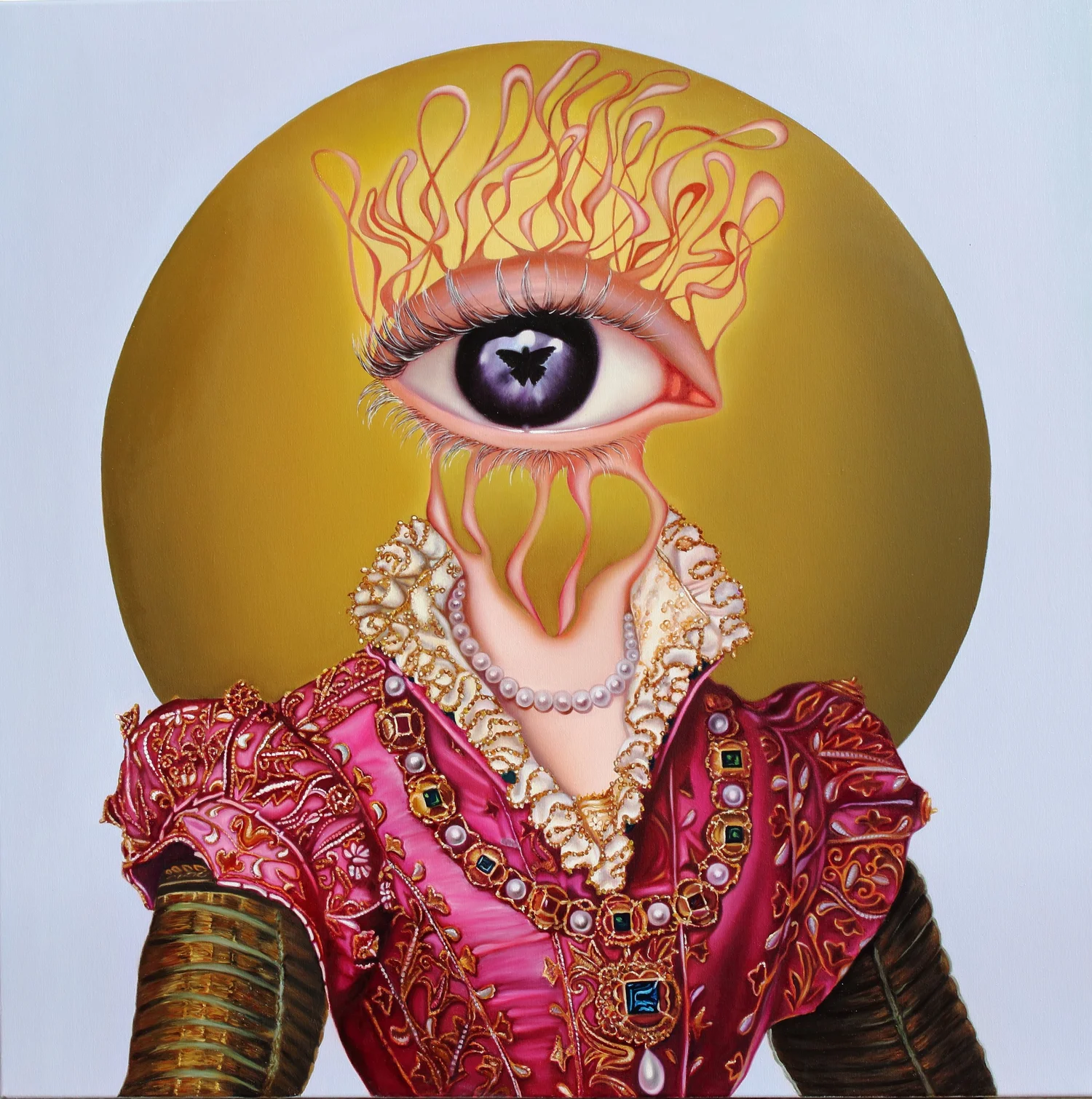
Make a Wish
90x90cm, oil on canvas
After Alessandro Allori’s portrait of Camilla Martelli de' Medici, 1580. Her figure transforms into a visual allegory, where sight is no longer bound by the limits of the human face but becomes the essence of being. The eye, replacing her head, serves as a symbol of knowledge, intuition, and inner vision. The butterfly reflected in the pupil represents a moment of transition, a fleeting dream captured in the gaze. This element adds a sense of magic—like a wish forming before vanishing into the wind. The title, "Make a Wish," speaks to a hope born from disintegration and reconstruction.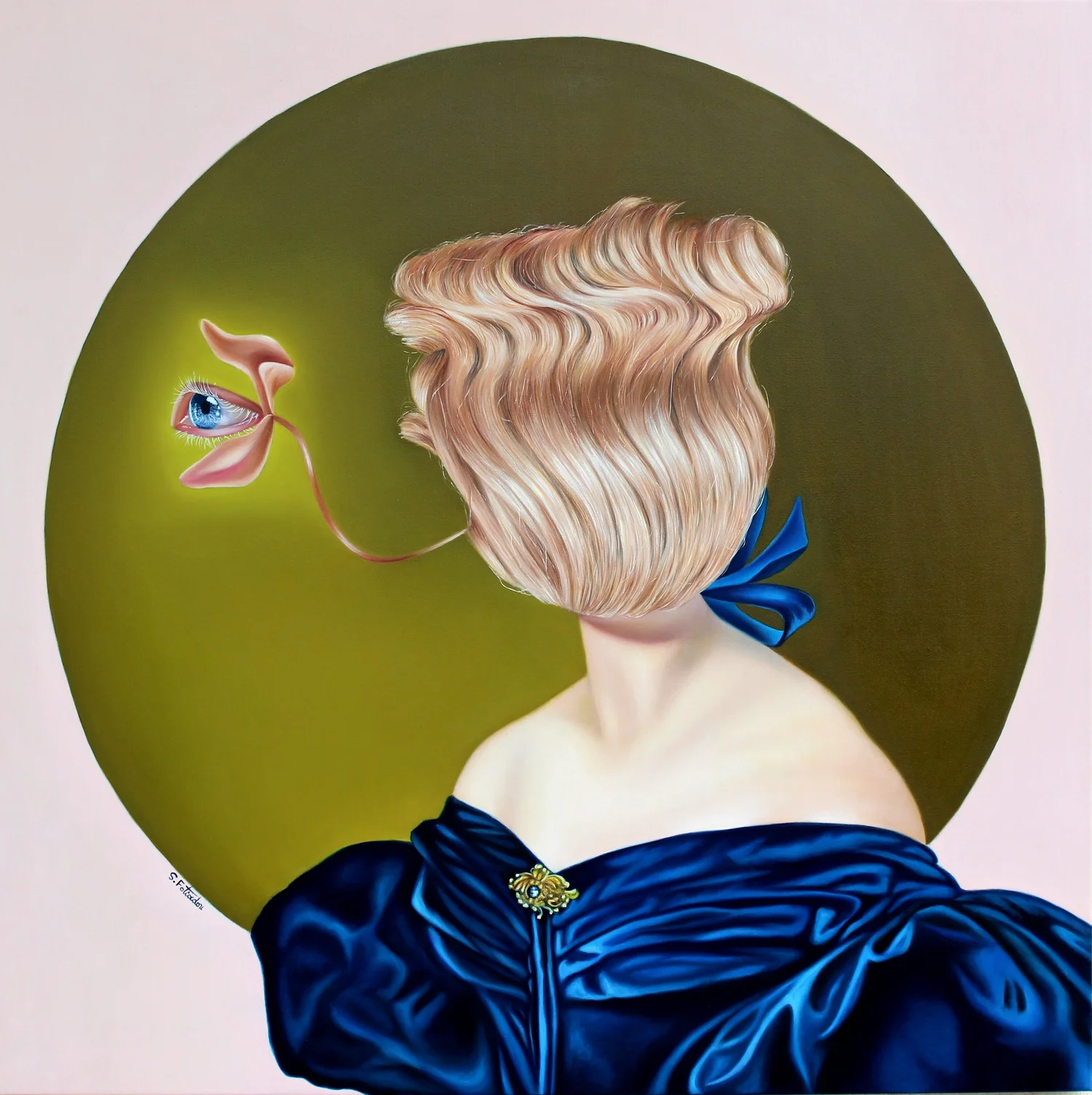
I expected flowers
80x80cm, oil on canvas
After Antonin Machek , 1835. Whatever sprouts here does not obey seasons or expectations, but a silent demand: to exist as you are, not as others wanted you to be. These were not flowers that bloomed. It was the persistence to see differently. The head turns backward, as if seeking a truth. In place of the blossom, an eye that allows no forgetting, only constant questioning. Whatever was inverted, whatever broke symmetry, became an opening—a crack from which truth can grow without the weight of roles. And so, the form, stripped of pretense, returns as a promise.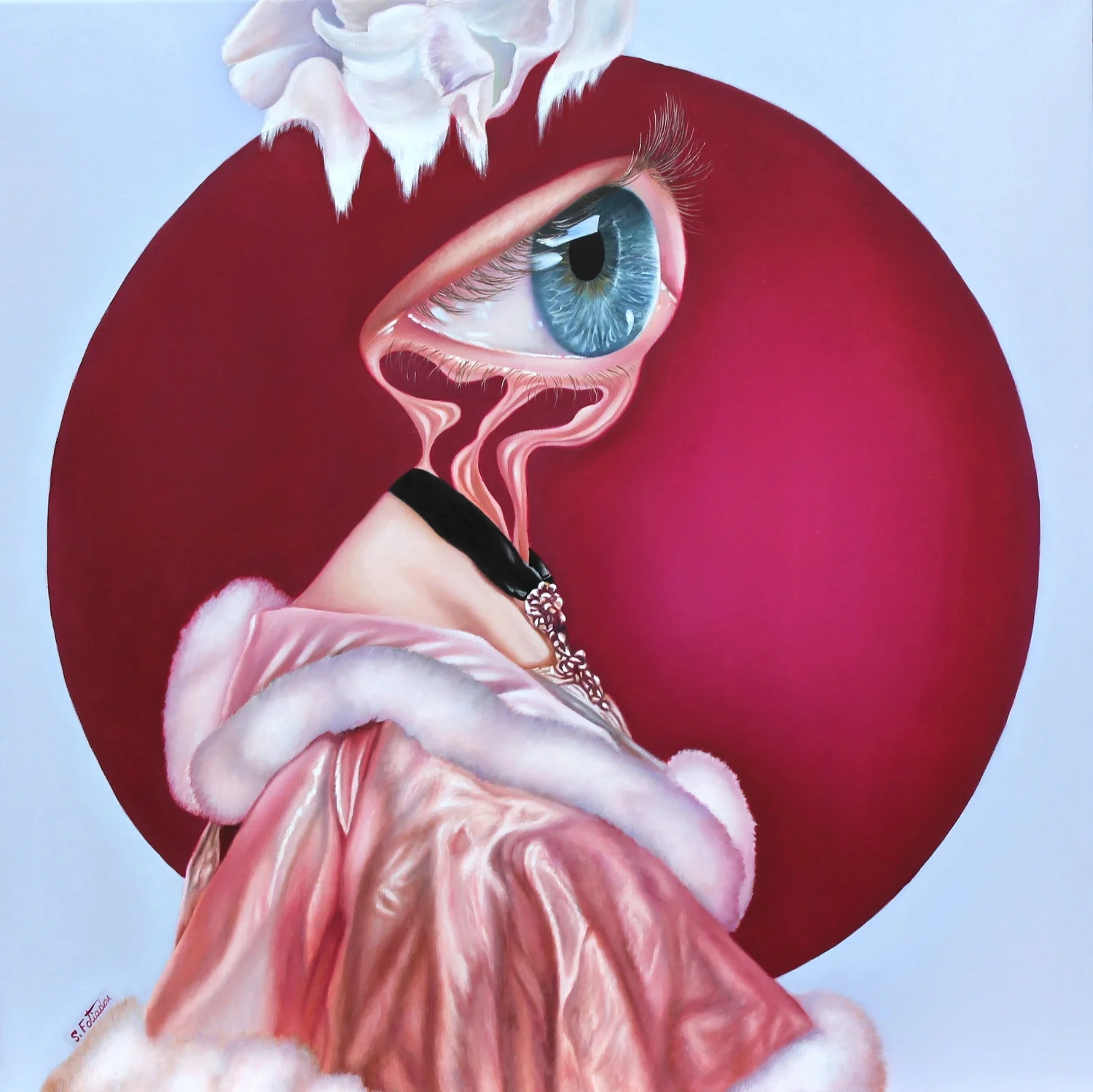
Amorous Hint
80x80cm, oil on canvas
After Joseph Karl Stieler’s portrait of Jane Plumer Callander, 1837. A profile, elegant and aristocratic. However, the replacement of the head with a large eye, gazing sideways as if searching for something elusive, transforms the composition. The connection between the body and the eye through fluid “tissues” evokes a sense of a fragile existence. The white petals floating above the eye resemble whispers—subtle hints of an imperceptible emotion that emerges and fades away. Perhaps they are signs of desire, a love expressed in an intangible manner, as suggested by the title.The background acts like a theatrical curtain, a pulsating surface that alludes to passion. The piece invites the viewer to experience the silent language of the gaze and of longing—never explicitly expressed, but hovering like petals in the air.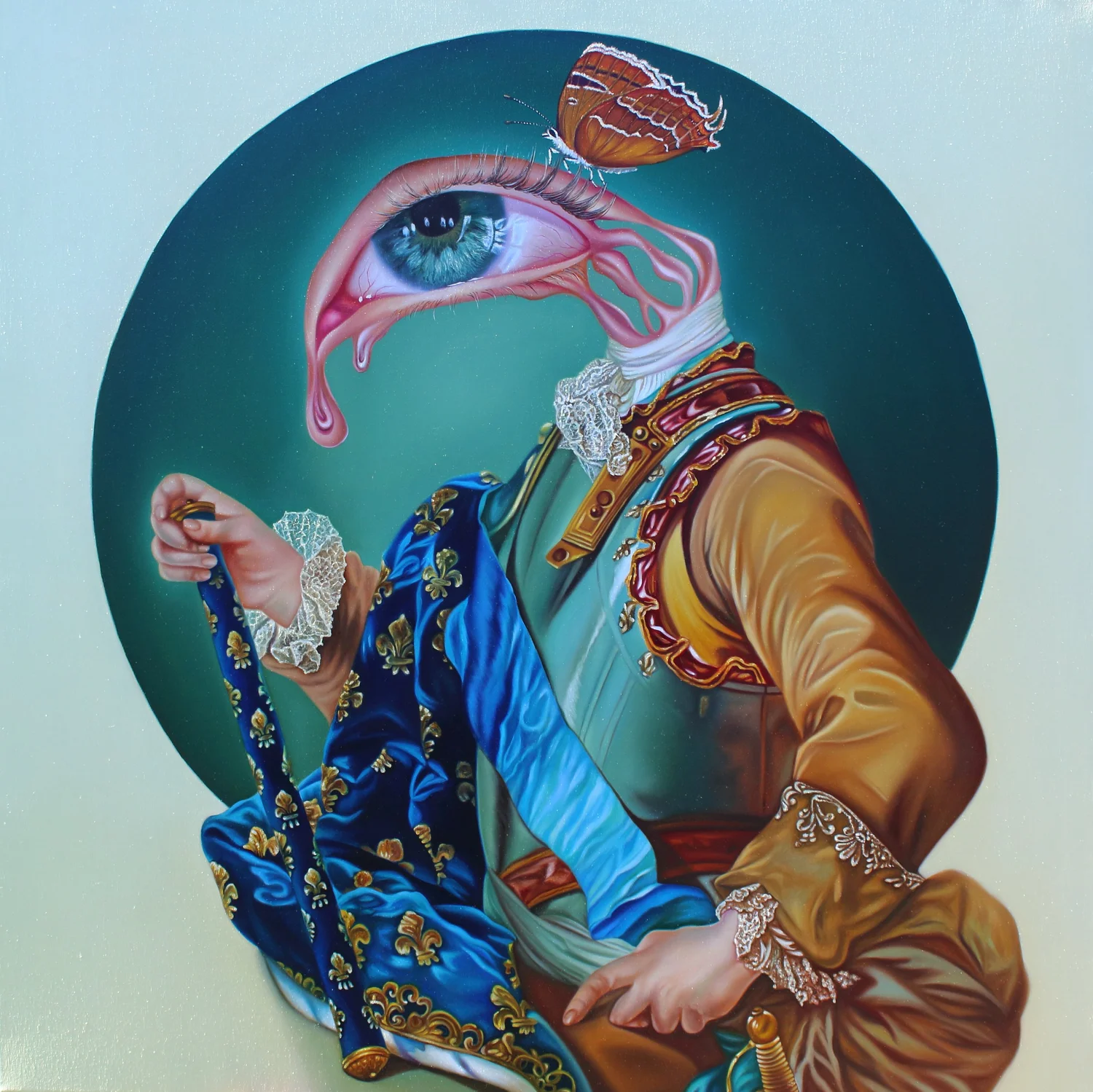
Promise
110x110cm, oil on canvas
The body of the young Louis XV, from Jean-Baptiste Leu’s painting, retains the attire, the precious textures—everything that symbolized power, masculine heritage, and royal identity remains in place. In place of the face, a large eye, shedding a tear, connected to the body through fluid tissues, reminds us of the human fragility hidden beneath symbols of authority. The butterfly, a bearer of hope, perhaps even a promise—as suggested by the title of the work—embodies the pledge made to the people, or to oneself: for tenderness, truth, or perhaps the right to emotional expression.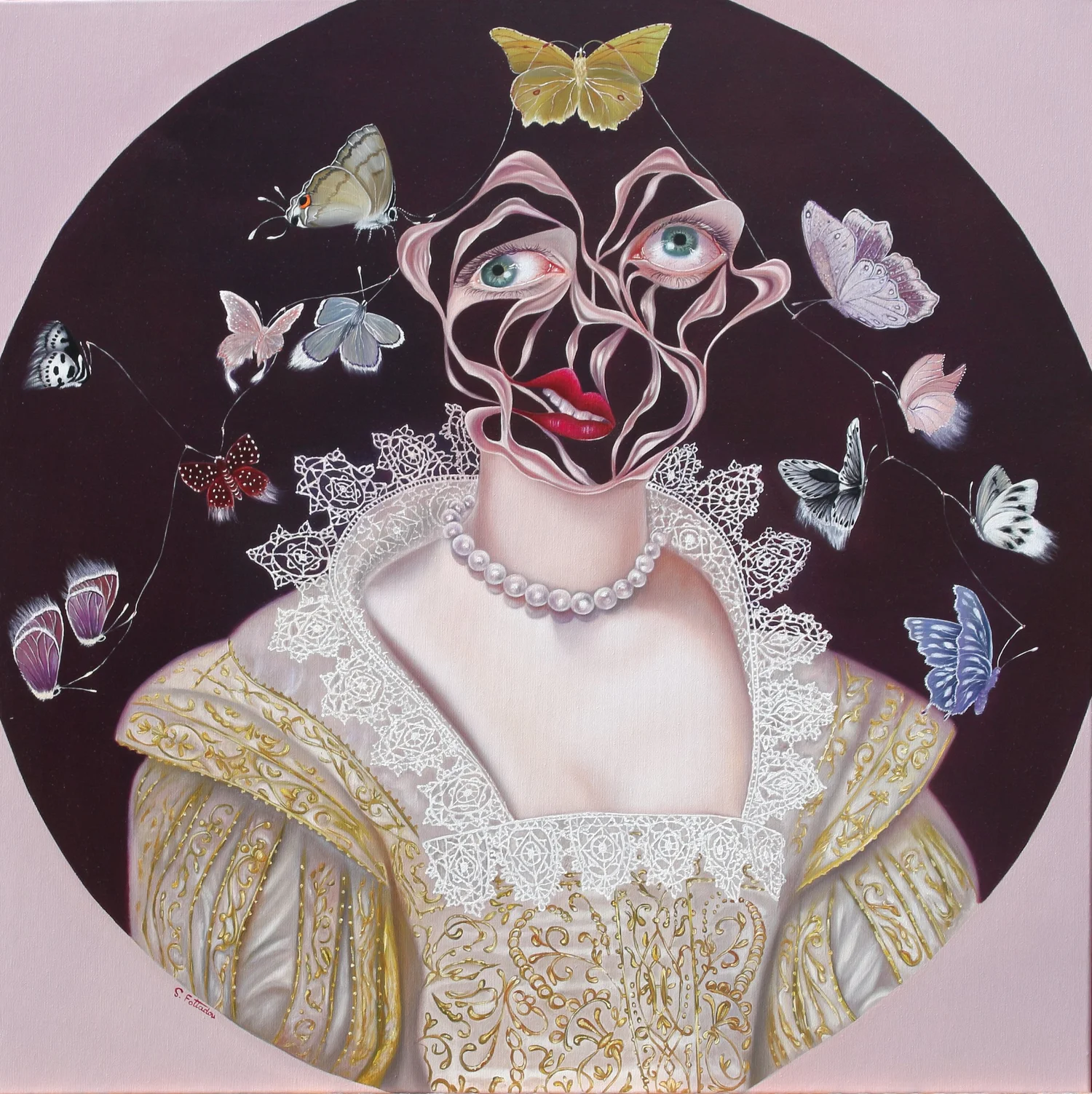
Golden Cage?
90x90cm, oil on canvas
The artwork is a reinterpretation of Anne Audley’s portrait, as originally depicted by Van Dyck. While preserving the historical figure’s elaborate, gold-adorned attire, this new interpretation departs from realism, embracing a transformative, almost transcendental state. The webs that dominate the composition erase her recognizable identity. This deconstruction aims to highlight the fragile nature of human existence. At the crown of her head, a golden butterfly with open wings appears like an orchestra conductor. Surrounding it, other butterflies are delicately connected by an almost invisible thread, suggesting a secret communication—an unseen dialogue between the forces that shape or dismantle an existence. Butterflies, symbols of transformation and freedom, take on an ambiguous meaning here: are they agents of rebirth or captors in a gilded cage?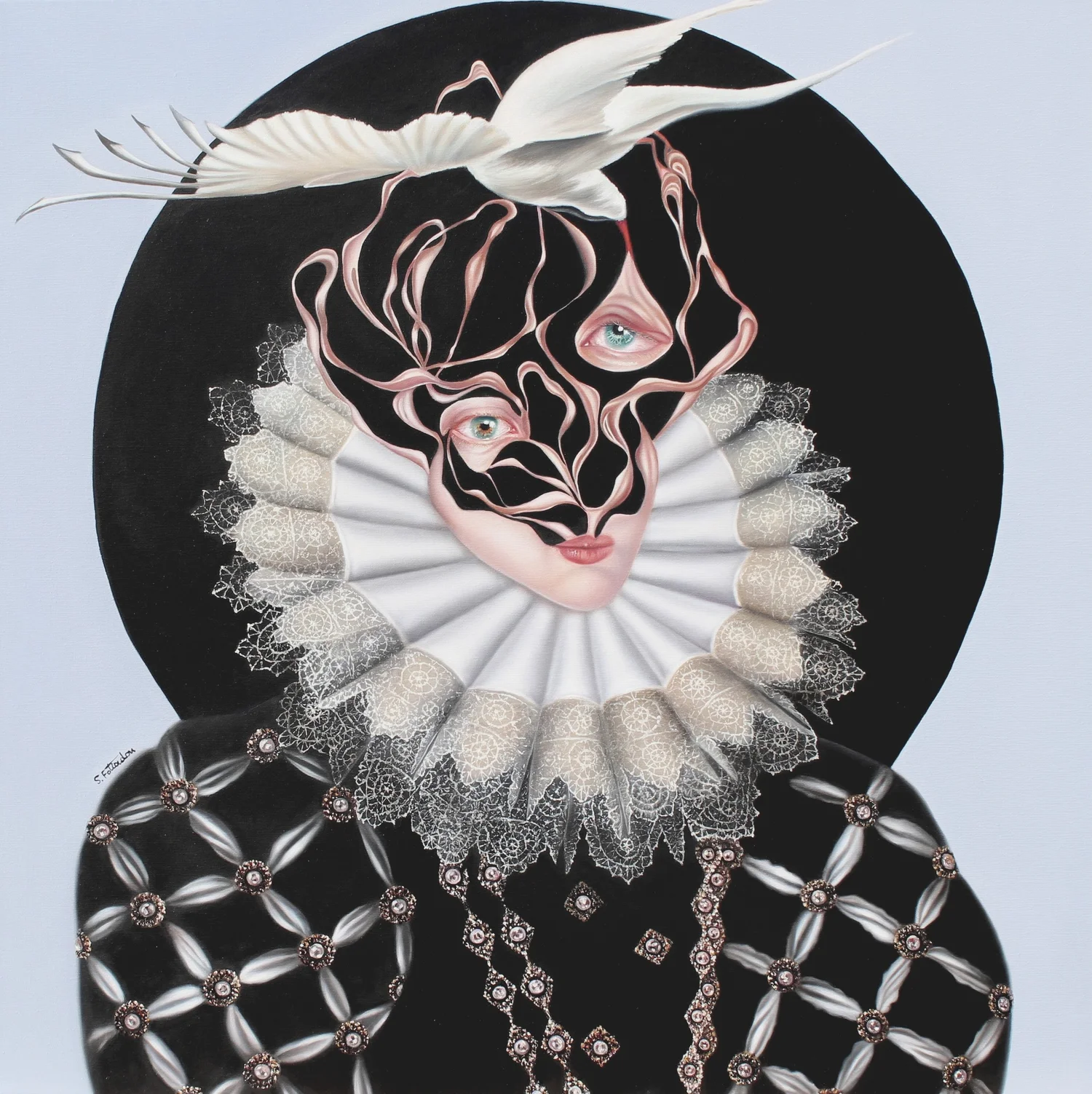
This Way
90x90cm, oil on canvas
The artwork reinterprets a classic portrait of a woman of power and prestige. However, her face undergoes a paradoxical transformation. A white bird pulls at the tissues of one eyelid with its beak, raising questions about power, control, and the shaping of identity over time. The title, "This Way," suggests guidance, a path, or even an imposed direction. Is the woman choosing to see in different ways, or is the bird’s intervention determining what and how she perceives? This work explores themes of authority, visual perception, and inevitable transformation, forging a connection between past and present. An enigmatic approach, challenging the viewer to contemplate identity, vision, and the manipulation of perception.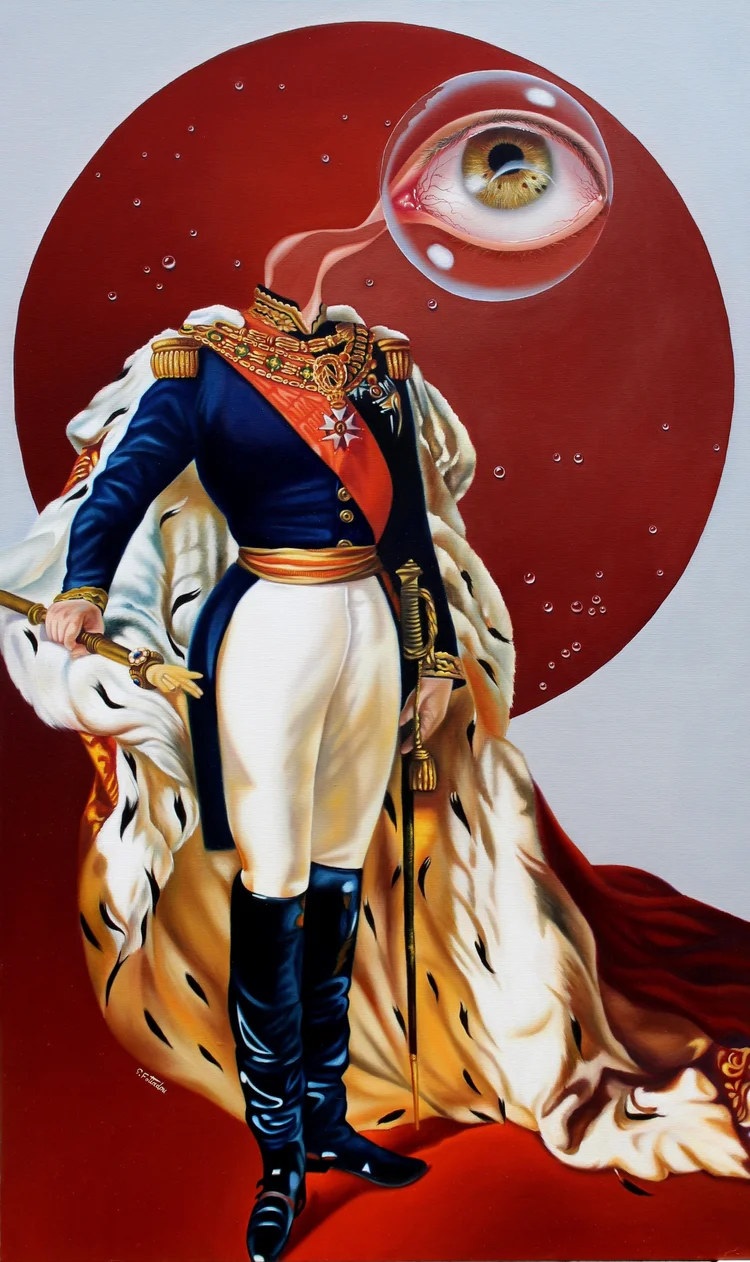
Expectancy
150x90cm, oil on canvas
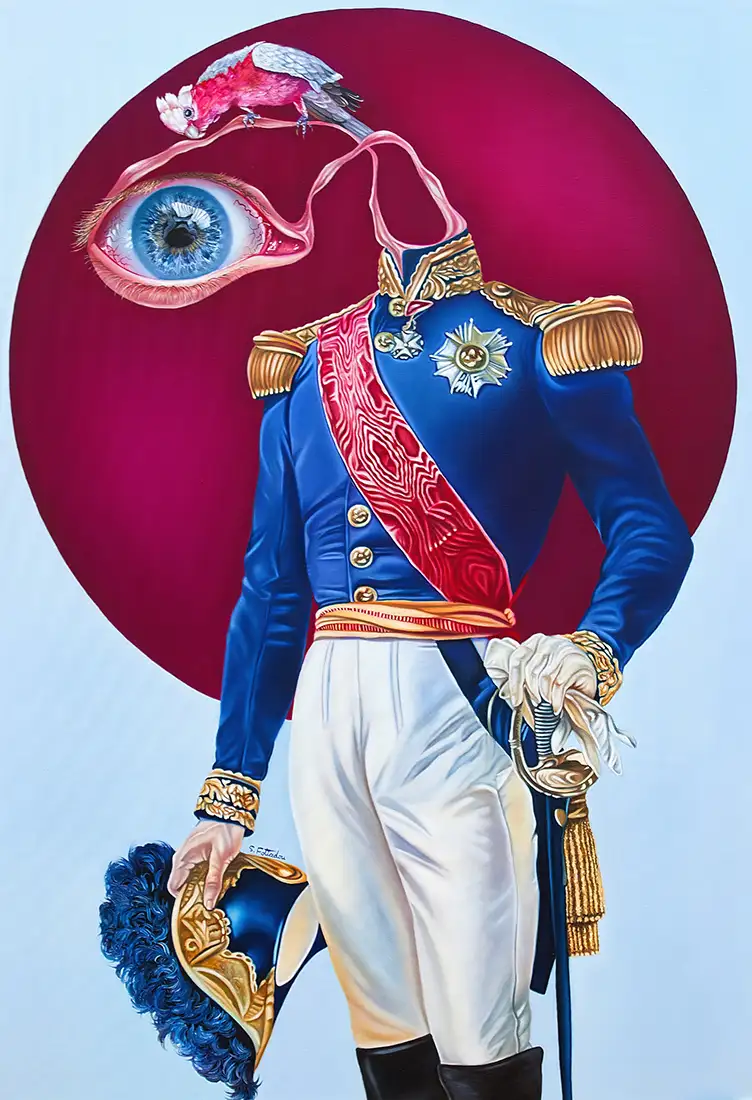
Starting from the original portrait of Napoleon by Franz Xaver Winterhalter (1853), the work attempts a deconstruction of the historical image of power. The human figure retains its imposing attire and symbols of authority; however, the face is absent and replaced by an enlarged, floating eye. This gaze functions as a symbol of vigilance, expectation, and control, while simultaneously suggesting vulnerability and uncertainty. Isolated within a transparent sphere, the eye both observes and is observed, raising questions about the relationship between power, consciousness, and historical memory. The circular red disk in the background intensifies the composition and alludes to a space in which anticipation of the future coexists with the weight of the past. The work does not seek to idealize the historical figure, but rather to renegotiate it, shifting attention from the individual face to the mechanism of power and the human anxiety that accompanies it.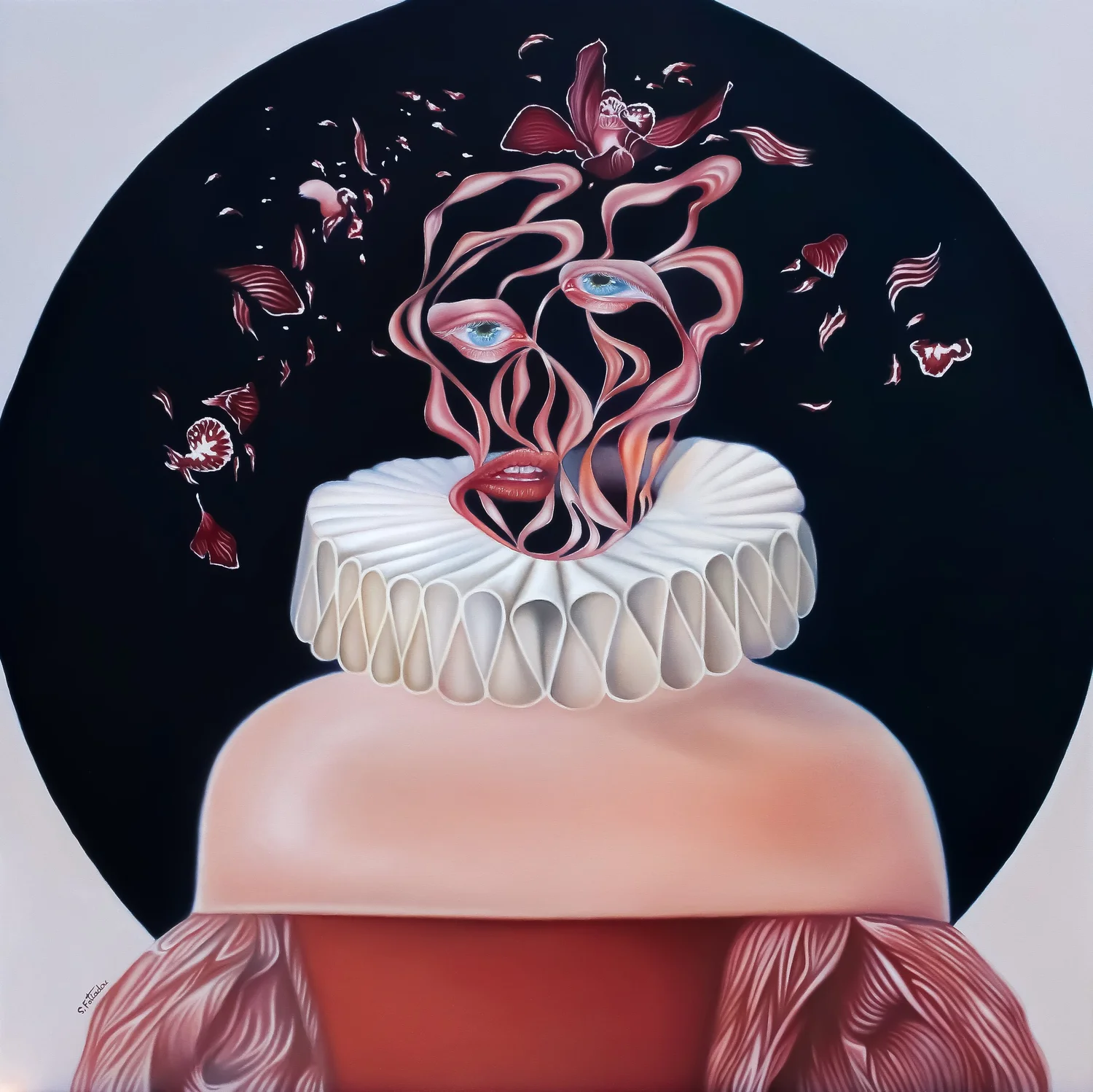
Self-mockery
90x90cm, oil on canvas
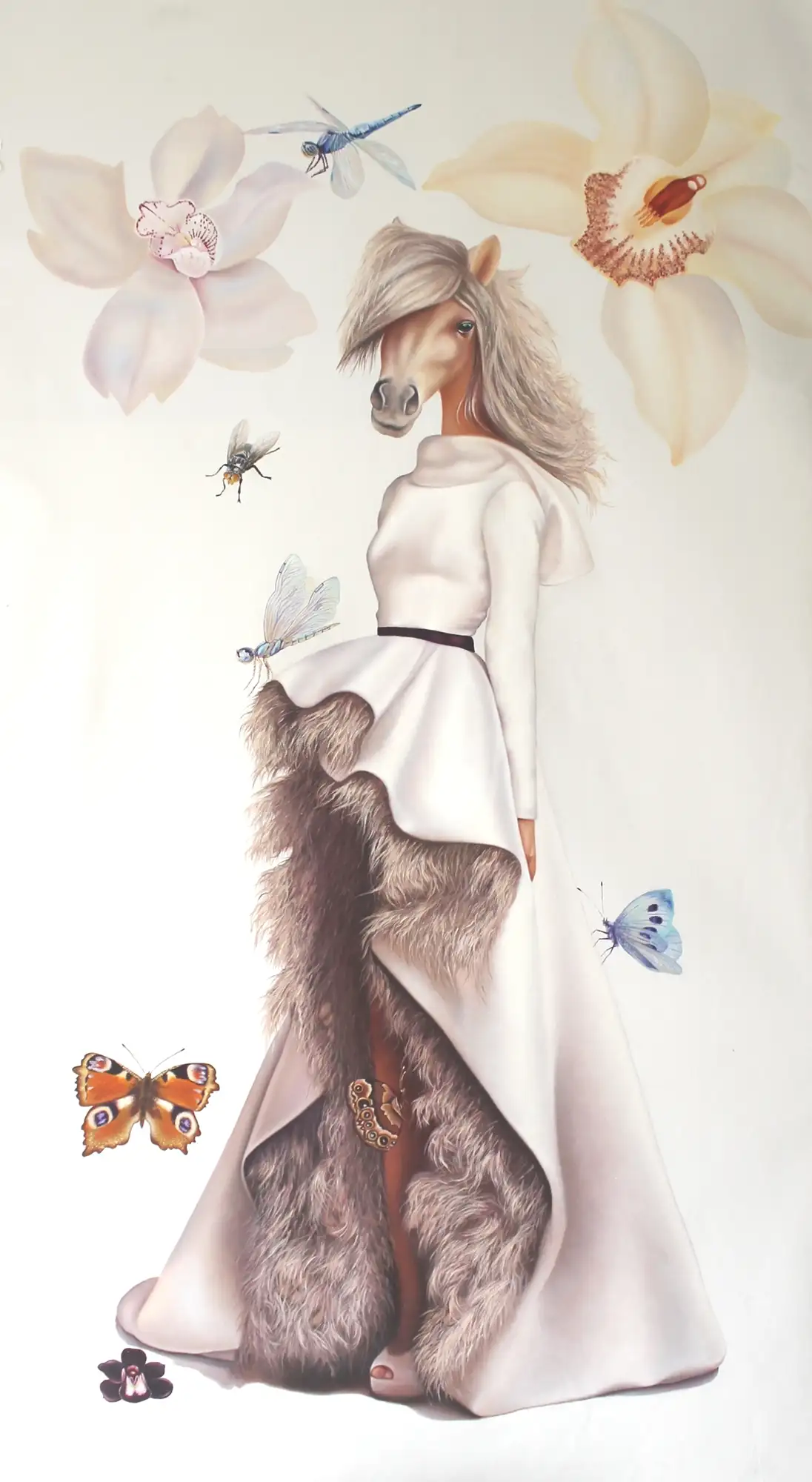
The work does not refer to a portrait of a specific historical period, unlike the other works. Costume elements from another era were used—abstract yet recognizable. The distorted image of the face is intended to symbolize our natural reactions to the current global crisis (economic, moral, environmental, and even health-related, since the period of its creation belongs to the COVID era). It reflects the human response to global challenges. Beauty, although it remains a fundamental concept, is subjected to contrasts and contradictions within the work, helping the viewer to gain a deeper understanding beyond the surface image. Nature seeks to soften this image by offering moments of joy, through elements that represent beauty in life.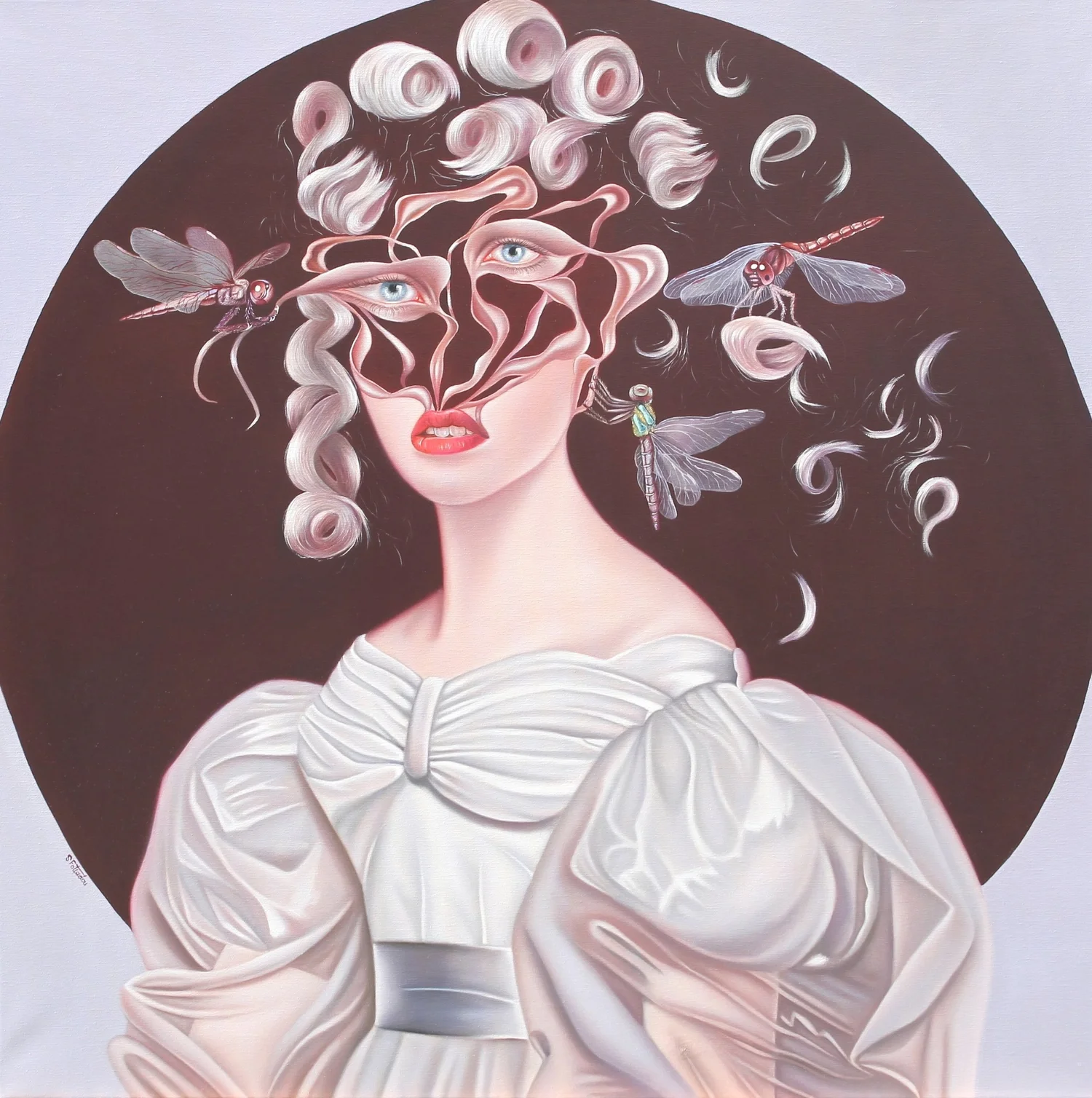
Sensualy
90x90cm, oil on canvas
After Ernst Joseph Thelott’s portrait of Elise Dorothea Friederike, 1833. I want to preserve the refinement and commanding presence of the original, but with a deeper sense of rebellion. Her lips remain intact— a remnant of her once-whole image. But in the upper part, the dismembered tissues of her face have eradicated all sense of identity. Even her blonde curls no longer belong to her. It is not just time that has carried them away but also the dragonflies—ethereal, playful, perhaps symbols of change and transformation—that drift along with the remnants of her former self. This is an act of both reconstruction and deconstruction. The woman once confined by the rules of her era now seeks rebirth through decay. Her face dissolves, but perhaps in this dissolution, she finds freedom.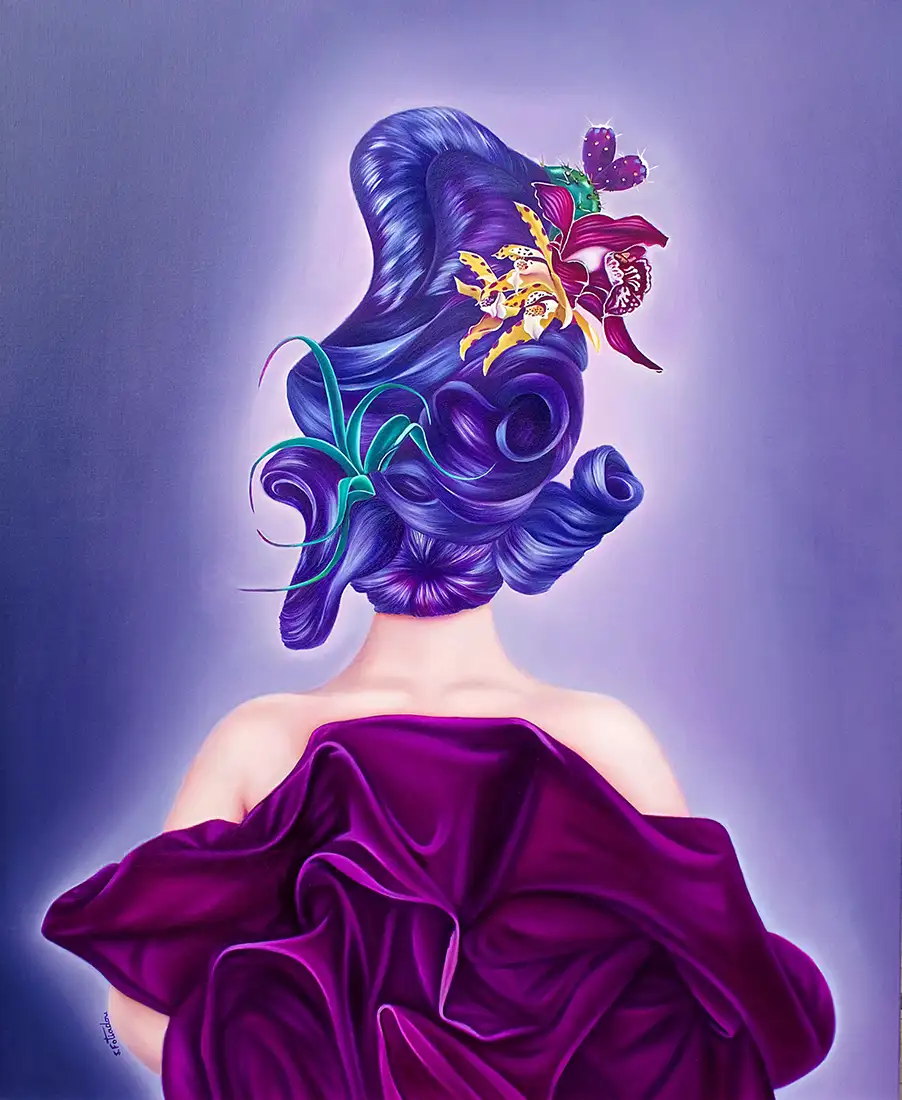
In and Out of Minds
120x90cm, oil on canvas
The figure, her body facing the viewer but her head turned away, embodies an ambiguity—a movement between two realities: the internal and the external. Her deep violet garment adds a sense of nobility and mysticism. The foliage, orchids, and cactus emerging from her hair are not mere decorative elements; they act as symbols of thought, of the nature that flourishes within us, and of the contrasts that shape us—tenderness and resilience, beauty and endurance. This work engages with the idea of the mind’s internal landscape, the interplay between what we choose to reveal and what truly exists within.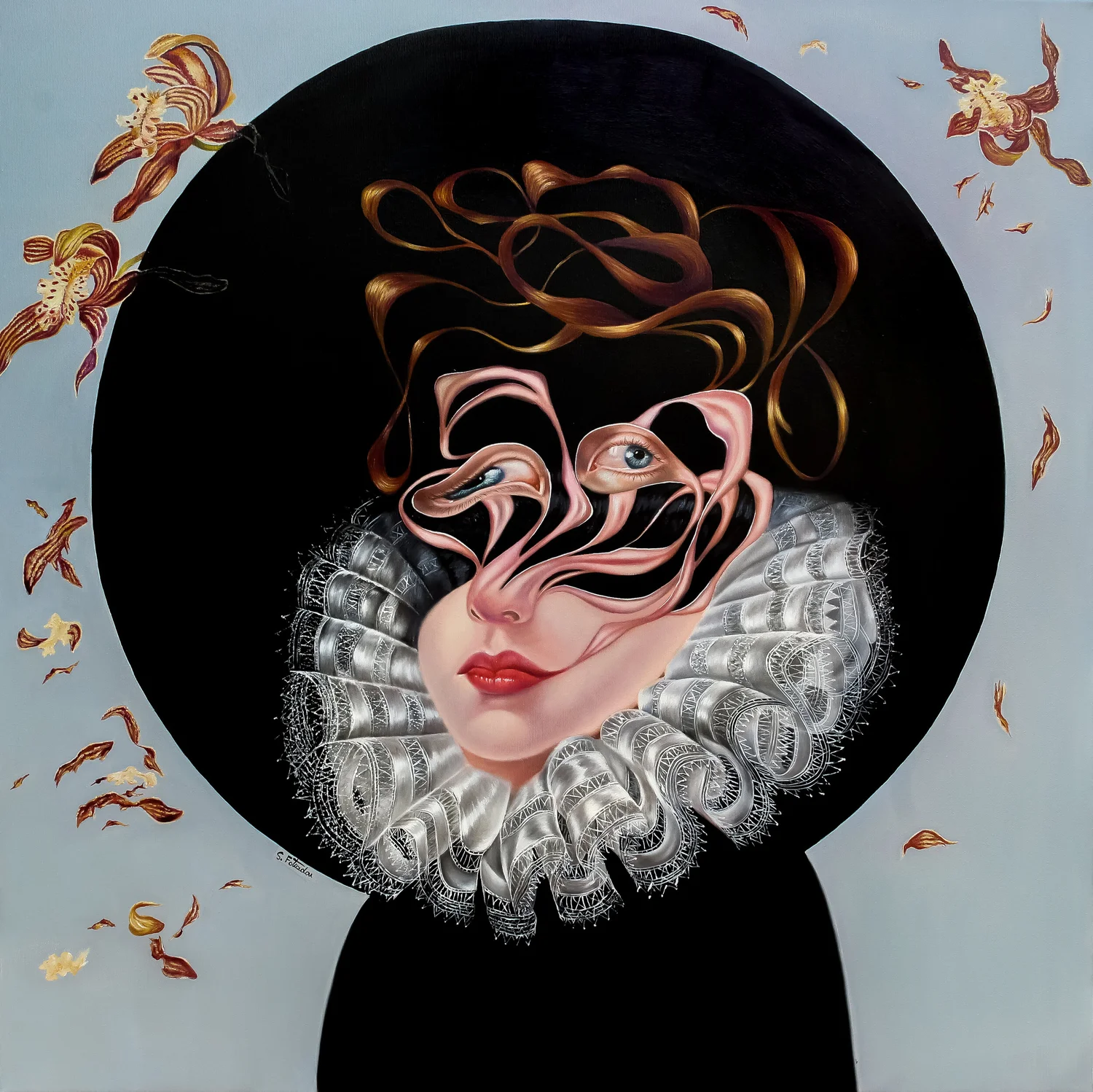
Must Look Behind the Picture
90x90cm, oil on canvas
The placement of the Renaissance collar of the English diplomat Edward Wotton, taken from the original portrait, highlights a sense of contradiction. By using a male collar on a female body, a paradox is created—perhaps an exploration of the symbolic and social constraints imposed by the era. The association of flowers with women is a connection deeply rooted in art and culture. This serves as a reference to the 17th–18th centuries, a period in which women were excluded by the norms of the time from the creation of art itself.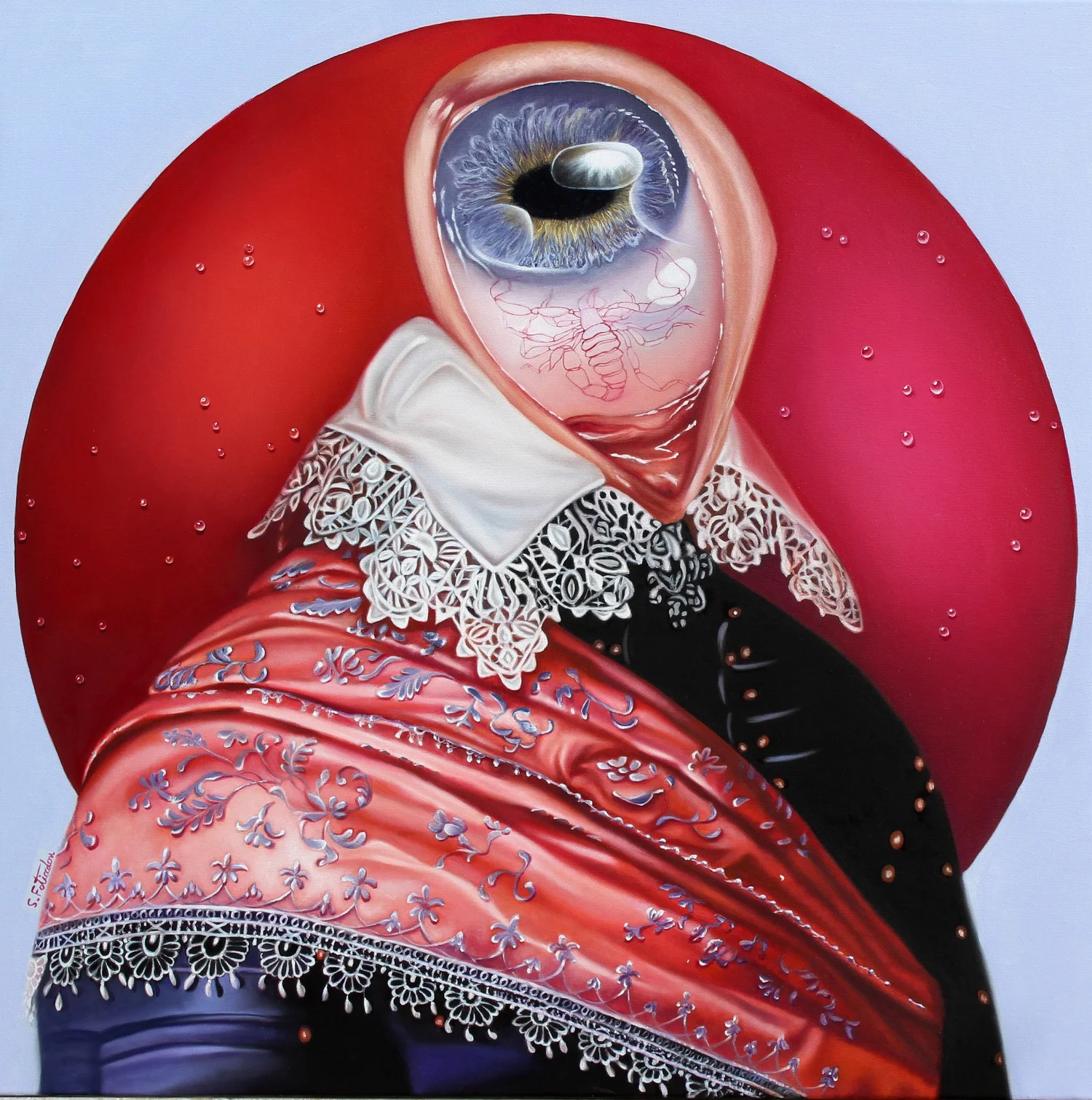
The Mirror of my Scall
80x80cm, oil on canvas
Edward Cecil, English Officer, by Michiel Jansz van Miereveldt, 1631 (National Gallery, London), is the original portrait. The symbolic dismantling of the canon presented in the original work gives rise to an alternative discourse that expresses the emotions it provoked. The scorpion, as a symbol of renewal and human anxiety in times of hardship, conveys the idea of a search for the essence of things, as well as the strength the human soul draws from confronting adversity. The anxiety and struggle expressed through the symbol of the scorpion reflect humanity’s inclination to overcome difficulties in an encouraging and dynamic way, highlighting its moral and spiritual dimension and imparting a sense of strength and empowerment. It emphasizes the importance of perseverance, inner exploration, and the emergence of the power that lies within the human soul.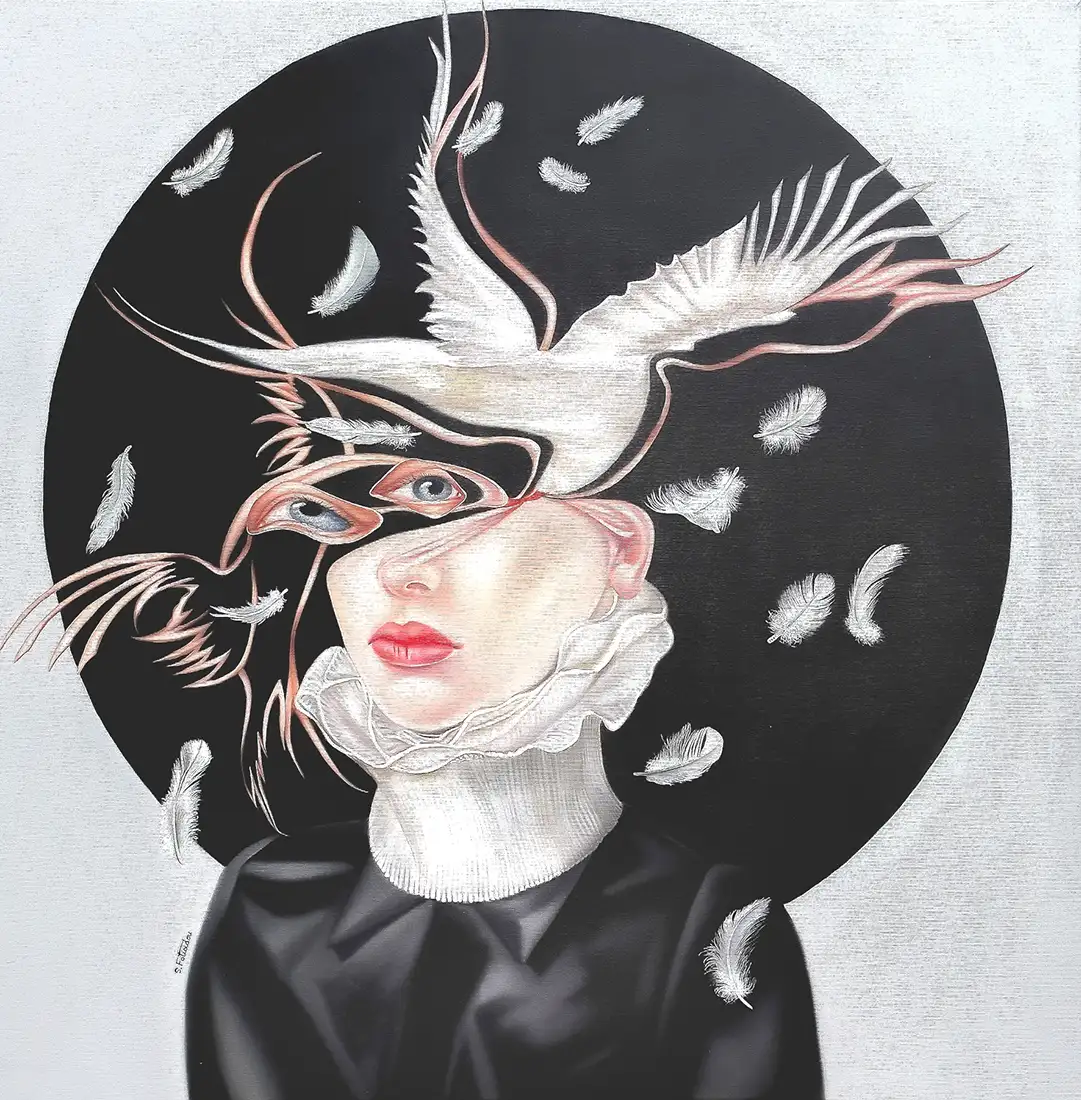
To the Point
90x90cm, oil on canvas
The form remains incomplete, as if harboring a secret intention not to allow full revelation. Whatever drifts away, whatever shifts, converges toward this intention. What dissolves is not lost.In its passage, the white bird scatters the landscape of gazes. The form leans into memory like a shadow that wishes to remember its own flight.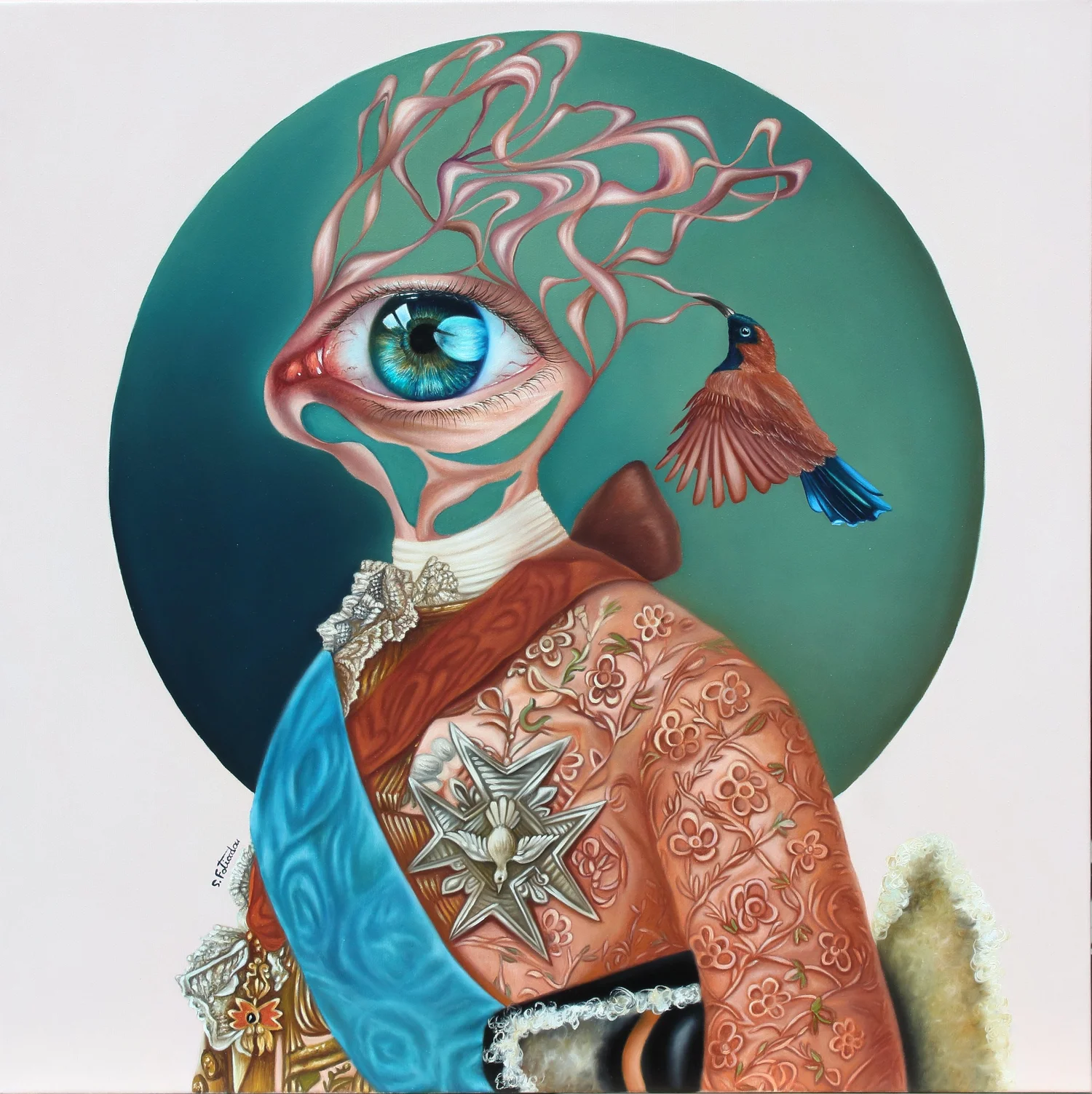
I am not a Fallen Angel
80x80cm, oil on canvas
After Jean-Martial Frédou 1760. Louis-Joseph-Xavier, Duke of Burgundy, lived only nine years, radiating beauty even in brief life. In my reimagining, I kept his body from the original portrait but replaced the head with a large eye, connected by two delicate threads. Above, fine threads float as a bird playfully dances among them, giving movement to stillness. Not a Fallen Angel—I belong to heaven. This piece explores the fragile link between past and present, the earthly and the celestial.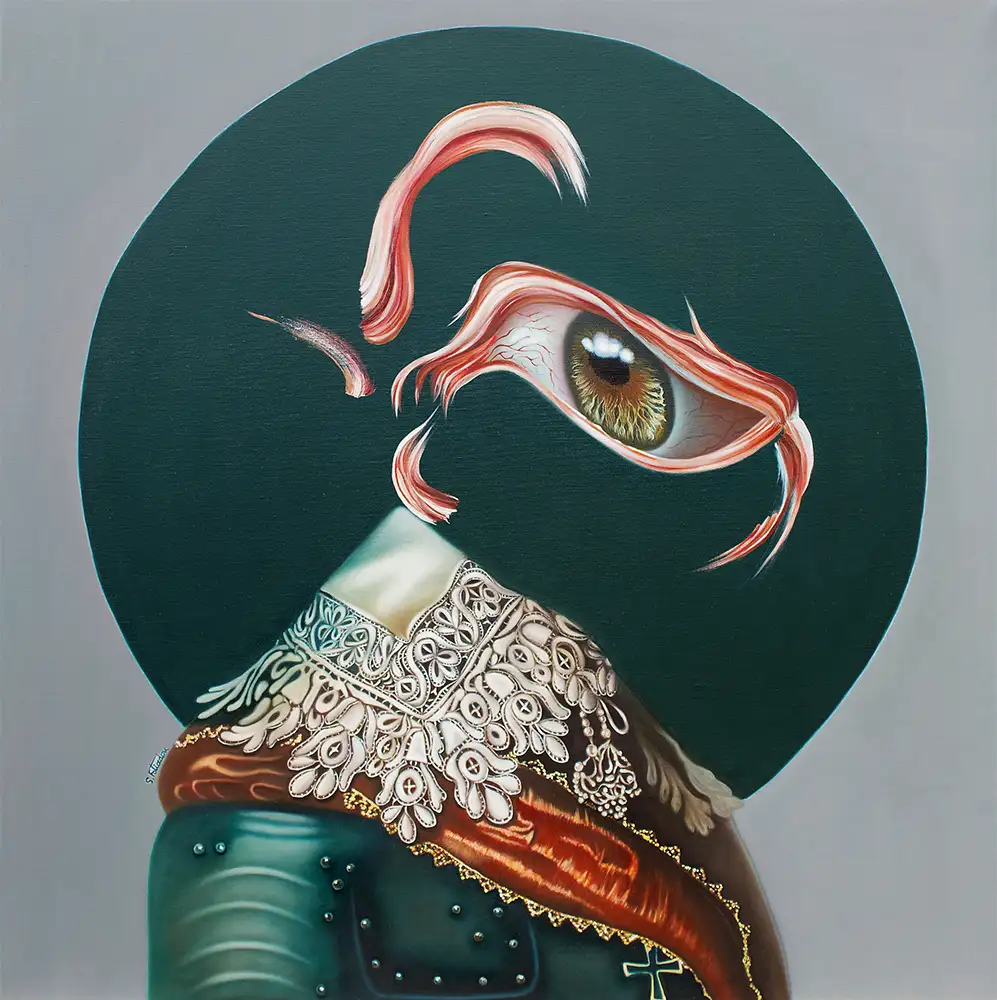
Intensity
90x90cm, oil on canvas
After Wybrand de Geest, 1632, (National Gallery, London) . Through the deconstruction of the original portrait, I sought to disrupt its familiar order, transforming it into a surreal image of the self. My intention was to create a new narrative, based on what the human figure has endured within the context of disturbances in Europe and beyond. The work incorporates contemporary developments and reflects the impact of social and political upheavals on the human condition. It is not merely a re-examination of the past, but a provocative acknowledgment of the present.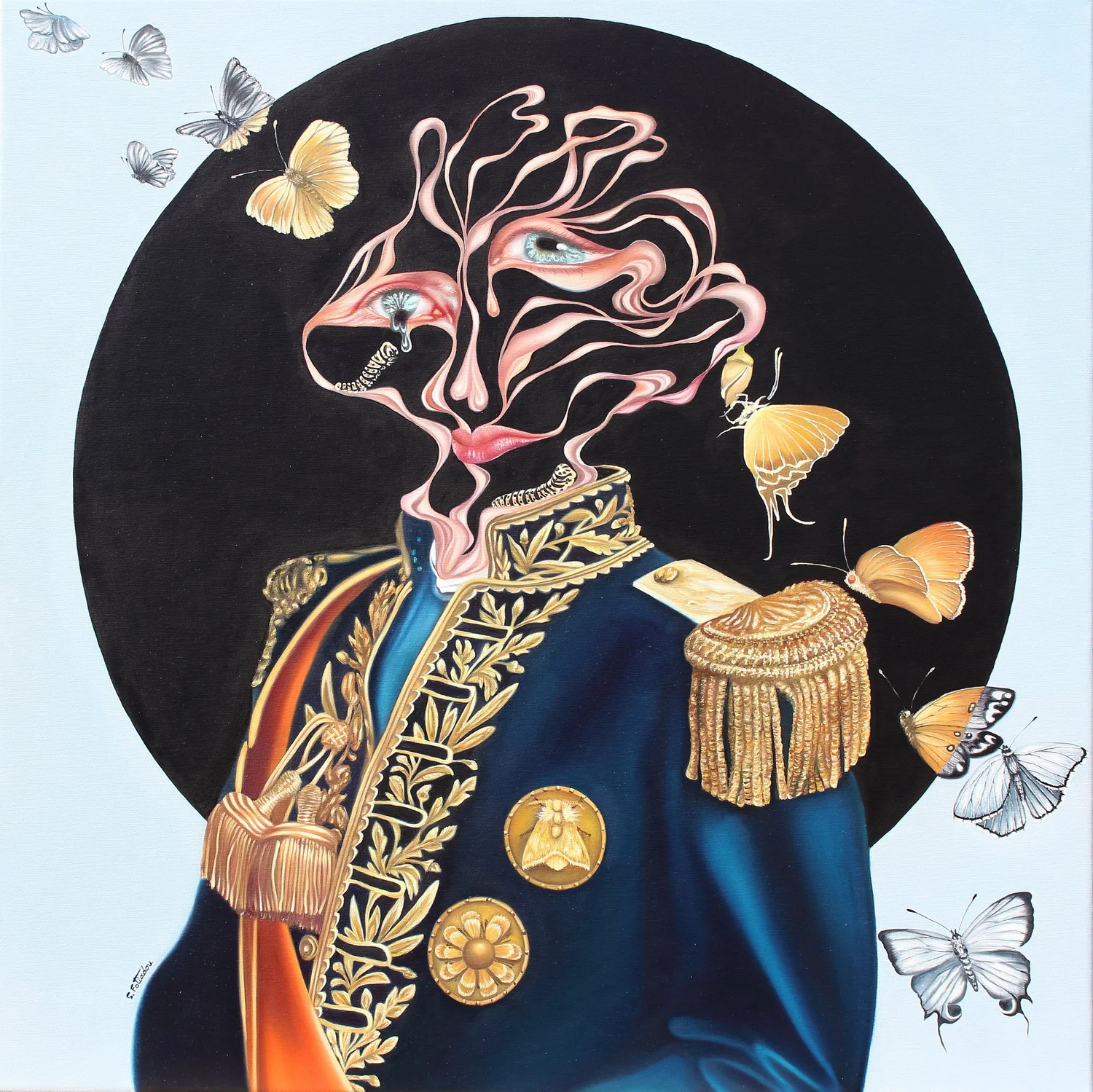
Is it a butterfly
90x90cm, oil on canvas
A figure, though dressed in a uniform of power and honor, bears a deconstructed face, as if its form has melted under the weight of assigned roles—a complex of fleshly curves, fragments of identity. Around it, butterflies hover—light, enchanting, free. Are they fantasies? Memories? Or its true nature striving to escape the uniform? The work acts as a mirror: we wonder whether what we see is a form or a transitional state—a butterfly or a metamorphosis not yet complete. And ultimately, perhaps the question is not about the subject of the painting, but about ourselves.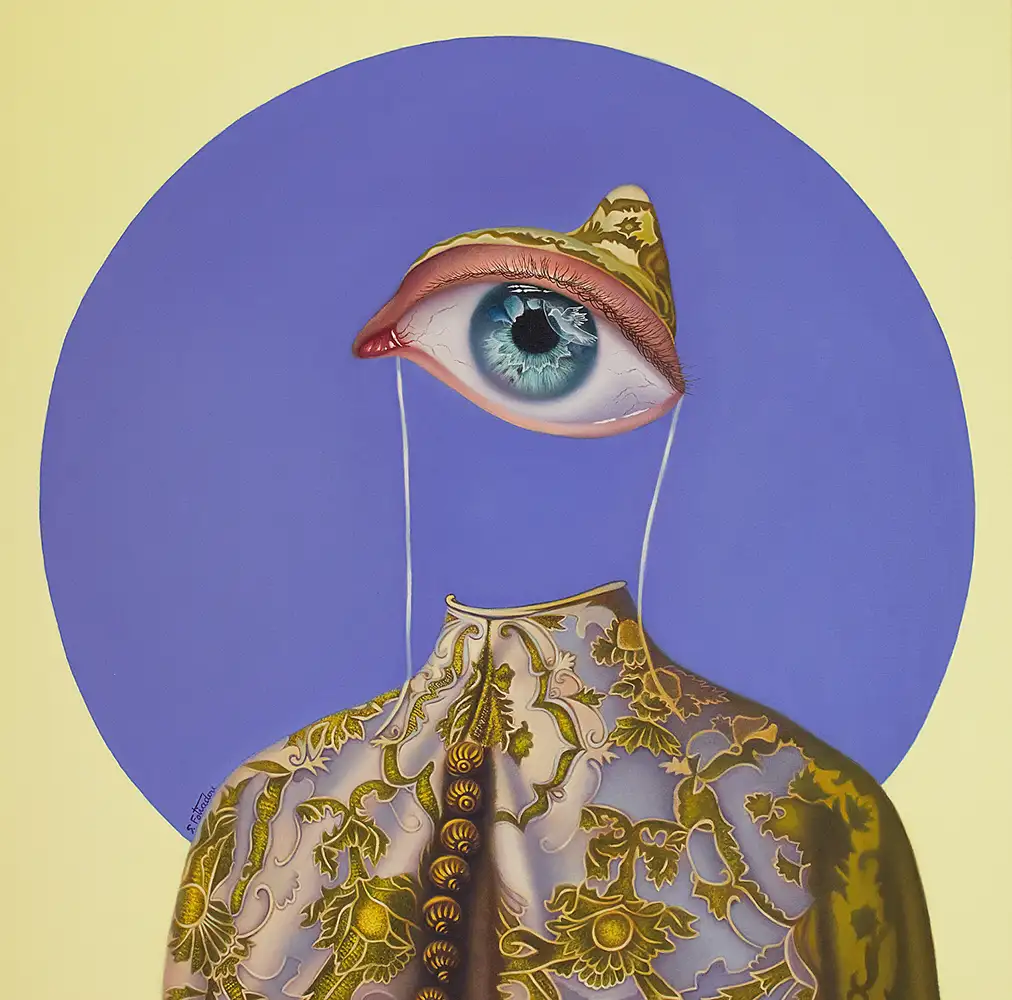
Escape from Myself
80x80cm, oil on canvas
In my work Escape from Myself, I engage in a dialogue with Giovanni Bellini’s Portrait of Doge Leonardo Loredan (1502), one of the foremost portraitists of the Renaissance (National Gallery, London). Through the observation and contemplation of the “eye,” I seek to deconstruct the rigid boundaries imposed by the hypocrisy of power—the decorum, prestige, and authority derived from institutional position. By retaining the body of the original portrait and replacing the head with a large eye, I shift the focus from identity to gaze, from the face to awareness. Reflected in the eye is a white bird with outstretched wings, a symbol of freedom, spiritual escape, and truth. The work functions as an act of inner escape: an attempt to liberate the mind from the imposed forms of power and their masks.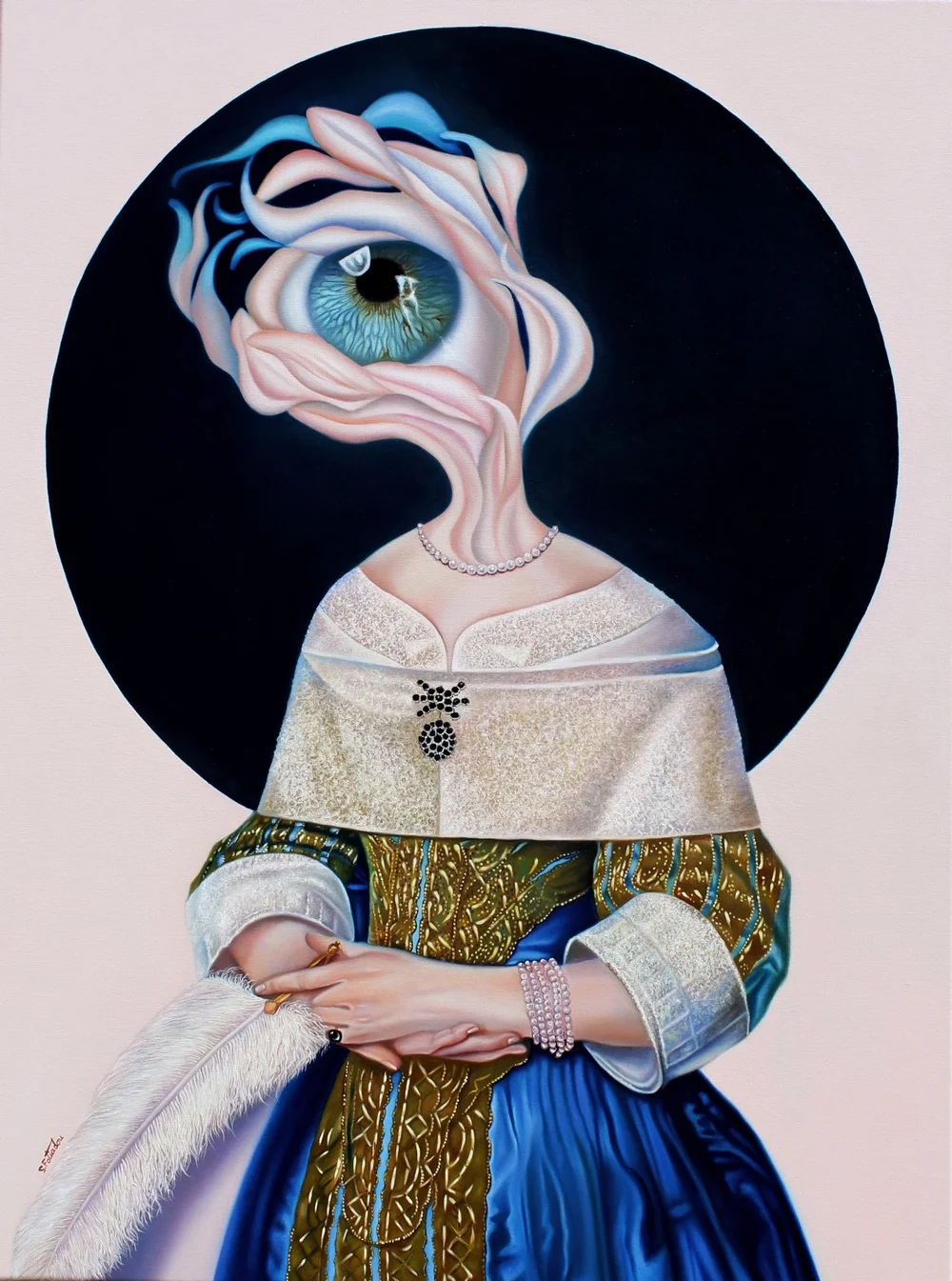
Woman in Love
130x90cm, oil on canvas
Susanna Reael by Issack Luttichuys, 1656. A new narrative of the original work, an exploration of femininity and emotional states. The crossing of her hands hints at a secret devotion to love. Her eye, surrounded by flower petals, seems to emerge from her very body, like a blossoming thought. As if the gaze itself is flowering. As if love is an inner bloom—fragile, yet powerful.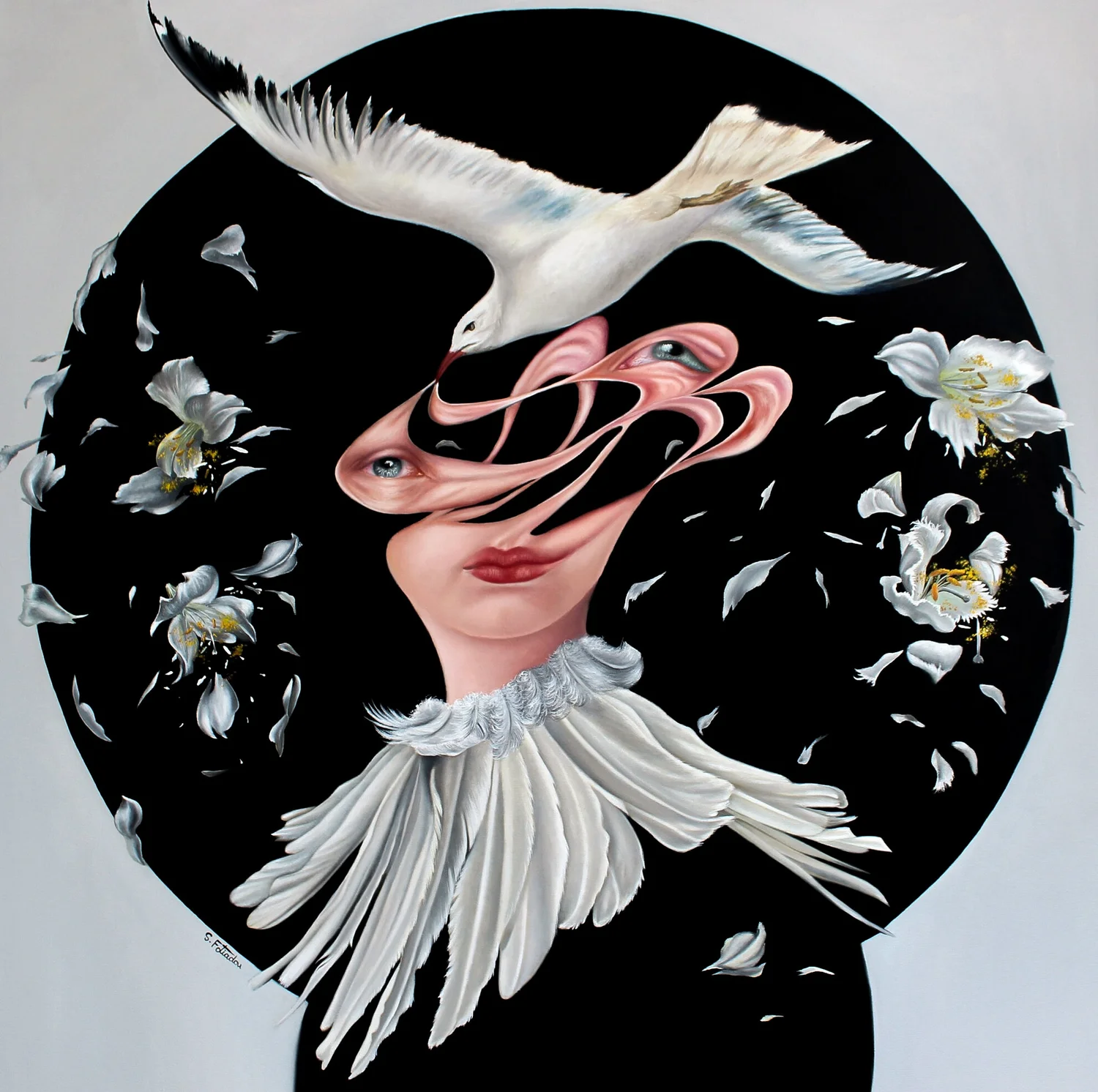
Freedom
90x90cm, oil on canvas
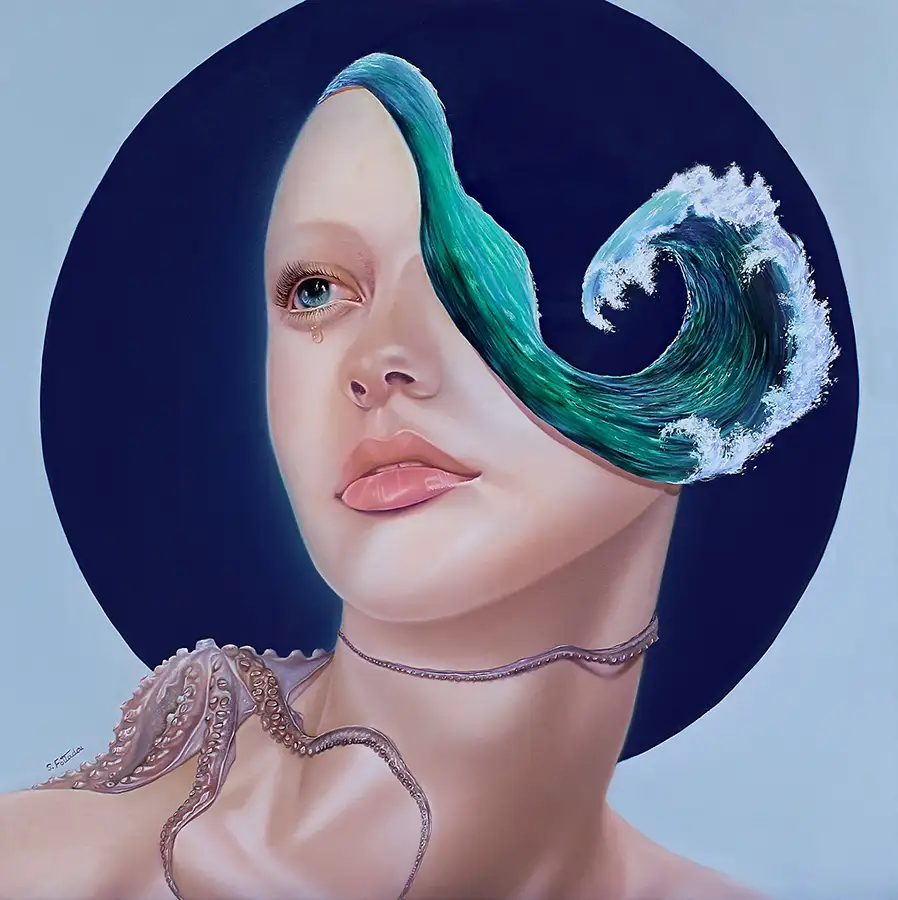
The painting captures a woman adorned with long, white feathers around her neck—perhaps a protective mantle, perhaps a reference to freedom and the lightness of existence. Her face is almost lost; apart from her lips, the rest seems to have transformed into fluid "ribbons" of tissue, erasing all sense of identity. A large white bird tugs at these strands with its beak, as if trying to free her from this state or transport her into a new dimension of being. White flower petals float around her, as if plucked by an unseen hand, reminiscent of the childhood game “Loves me, loves me not”—an allegory of uncertainty and the search for answers to unresolvable questions.The title, "Freedom," carries an ironic weight: here, freedom is not depicted as a clear state but as a process filled with conflicts and tensions.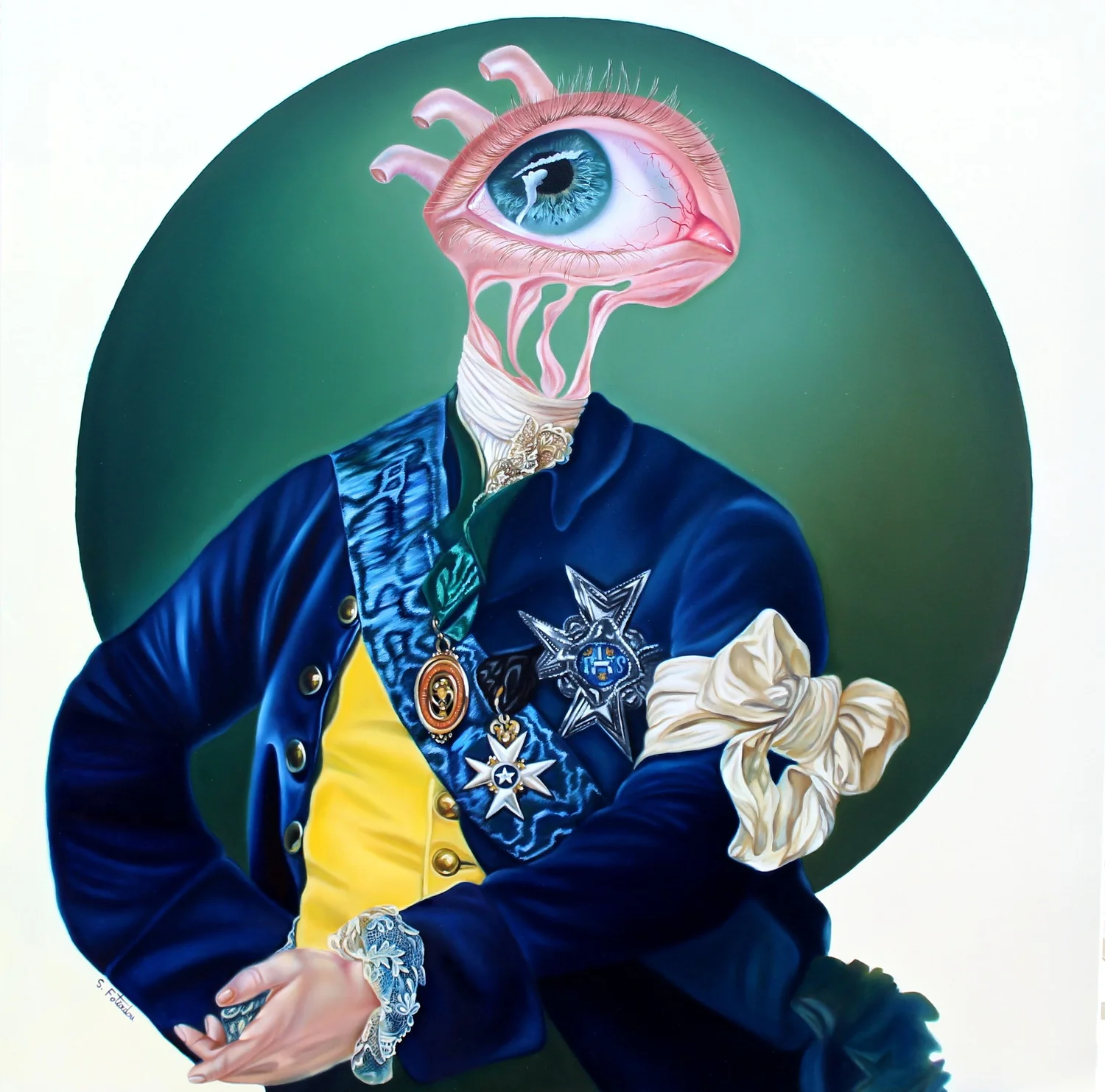
Freedom Message
100x100cm, oil on canvas
Gustav III, King of Sweden, with the amulet of freedom, after Alexander Roslin. The figure from the past, regarded as an object of respect, develops a distinct voice that seeks to speak of greater freedom. The ship’s funnel, as a symbol of continuous searching and striving for something new, aims to highlight the human perception of the unknown and the unexplored.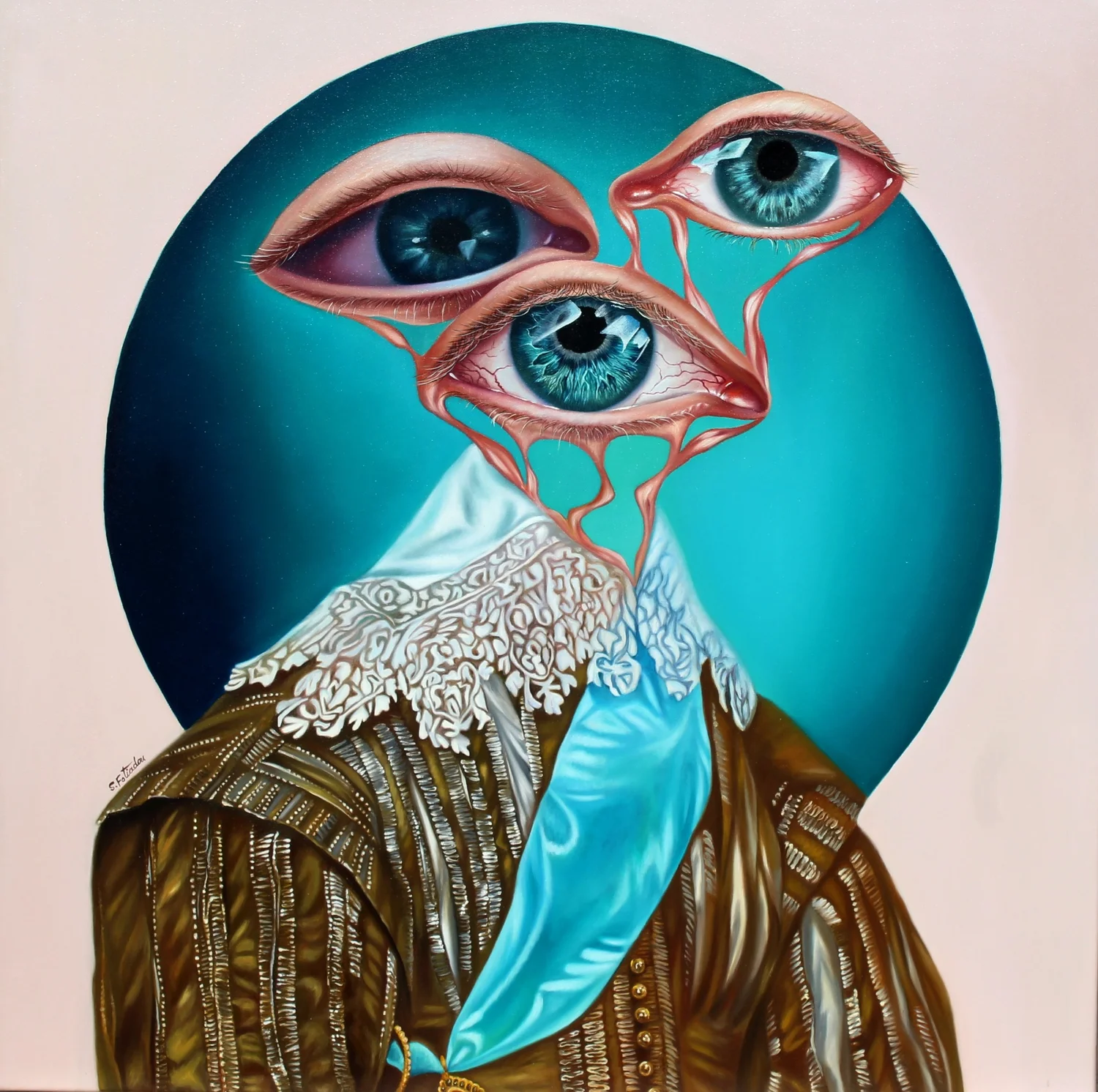
Wise Whisper
90x90cm, oil on canvas
Wise Whisper is a meditation on inner perception and silent knowledge. Drawing from the 1632 portrait of Charles I of England by an unknown artist, the work uses the historical image as an archival trace rather than a faithful reference. The figure’s head is replaced by three interconnected eyes that turn inward instead of outward, symbolizing intuition, memory, and expanded awareness. Vision here is not observation, but introspection — a form of knowing that exists beyond language. The circular field in the background functions as an inner horizon, a contemplative space detached from linear time. Wise Whisper invites the viewer to slow down and trust the subtle, almost inaudible guidance that connects silence to wisdom, memory, and light.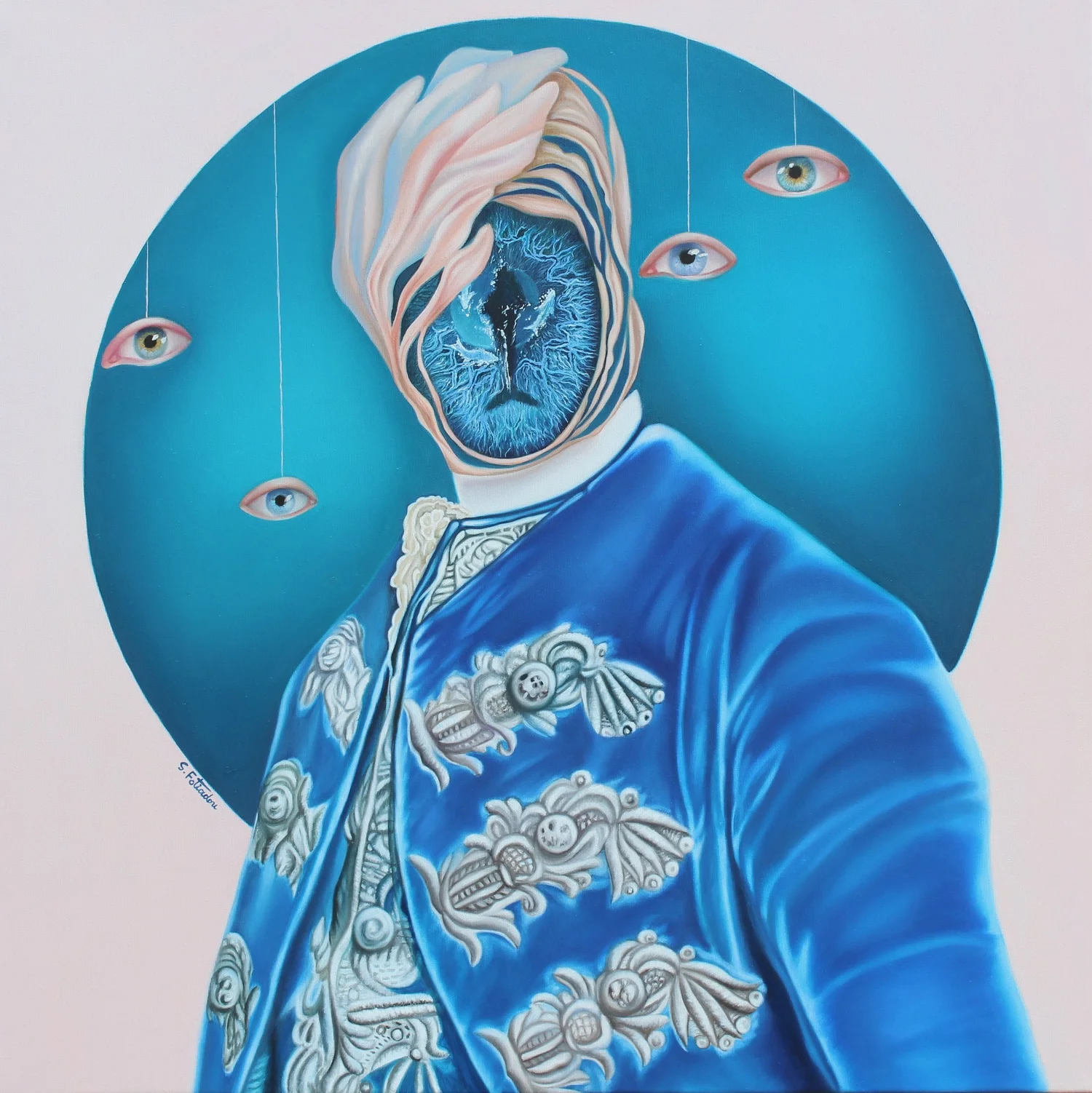
Breeze in my mind
80x80cm, oil on canvas
After Lisiewsky, 1762 . The work functions as an inner topography of the mind, where the human figure is transformed into a field of psychological and spiritual exploration. The face is deconstructed and replaced by an organic form, suggesting the fluidity of identity and the continuous transformation of human consciousness. The floating eyes act as symbols of observation, inner awareness, and multiple levels of perception—gazes directed both toward the external world and into the depths of the self. The circular form in the background alludes to a psychic space, creating a sense of isolation as well as protection. The clothing, with references to historical and decorative motifs, contrasts with the distortion of the face, reinforcing a dialogue between past and present. The work speaks of the silent intensity of thought and the invisible movements of the mind—a breath, an inner breeze, shaping emotions, fears, and desires.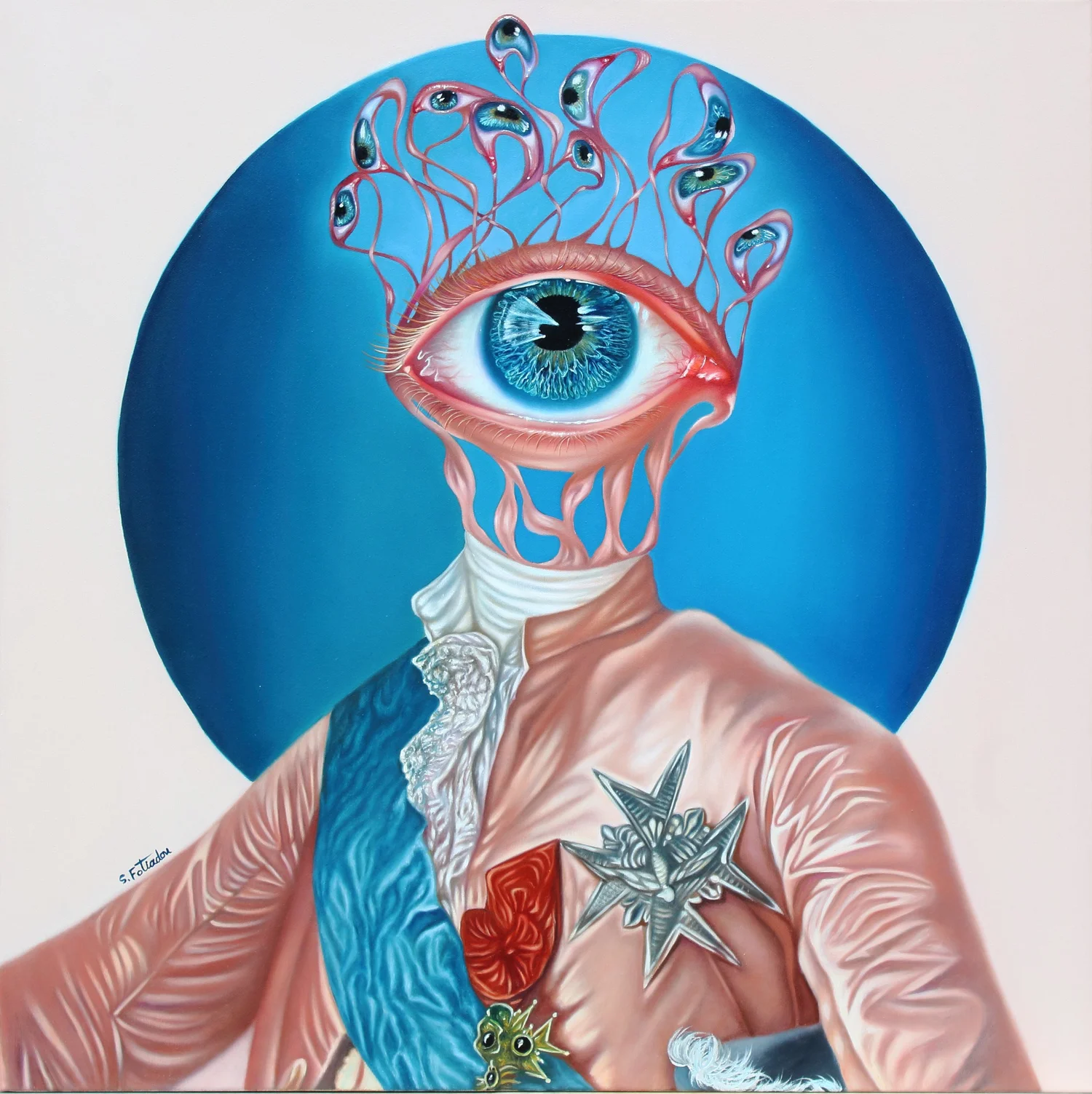
Increased empathy
80x80cm, oil on canvas
Increased Empathy explores the expansion of human perception and the transition from an individual gaze to a deeper, collective awareness. The gaze functions as a central symbol of understanding, vulnerability, and connection — not merely as a tool of observation, but as a vessel of experience. The multiplicity of eyes suggests the ability to see beyond the self, to feel the presence of the other, and to acknowledge the complexity of existence. Empathy is presented as an active state, a form of knowledge that emerges through conscious observation and emotional openness.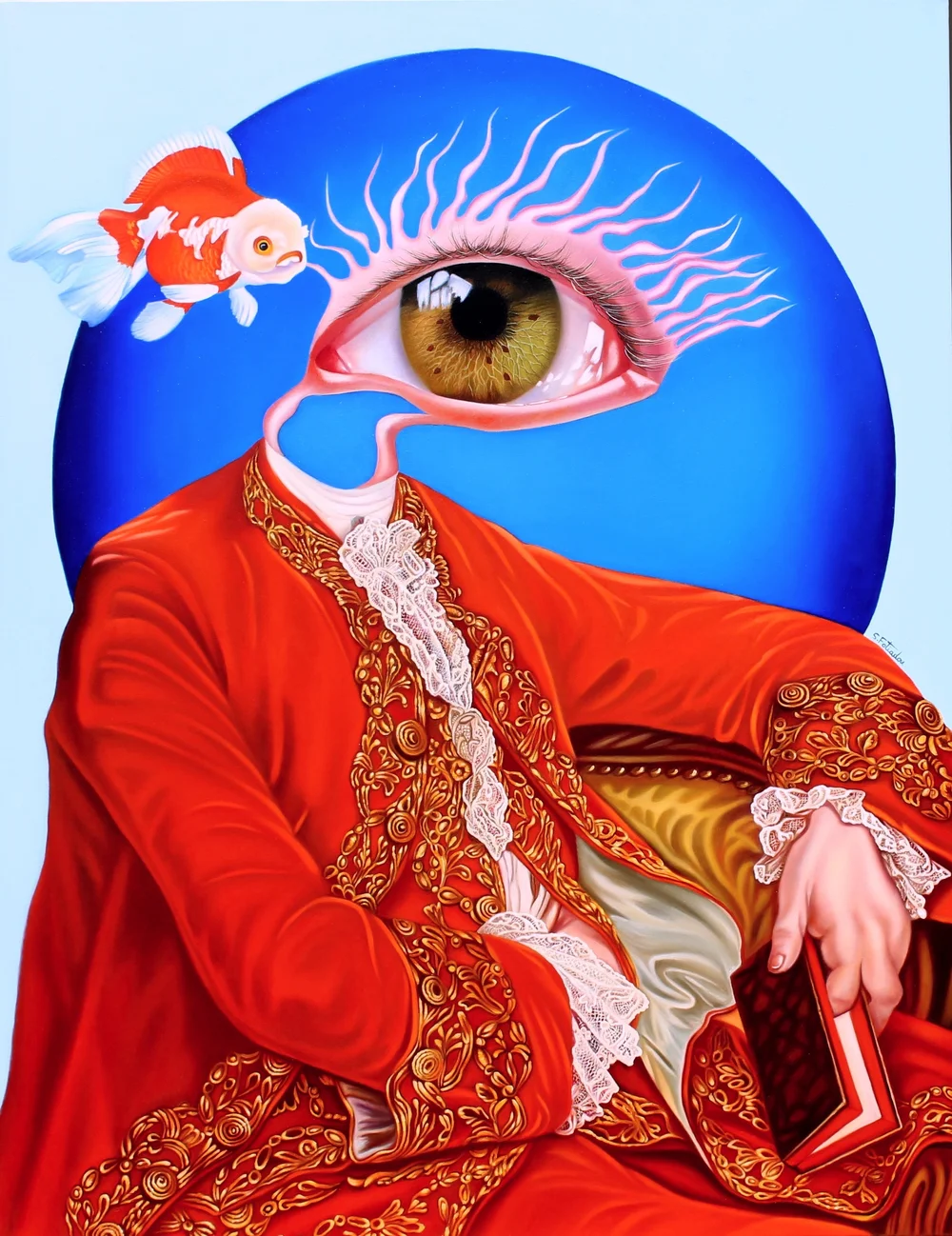
Reflections
130x100cm, oil on canvas
After Francois Drouais , 1772. Reflections speaks of a gaze that does not turn outward, but returns inward to the self. The eye dominates as a site of thought and introspection, while the body remains calm, almost ritualistic. The fish functions as a symbol of fluidity, silence, and transition. It moves between the conscious and the unconscious, like thoughts that emerge when we allow time to slow down. Reflections explores the relationship between identity and observation, image and essence — where thought becomes reflection, and reflection transforms into awareness.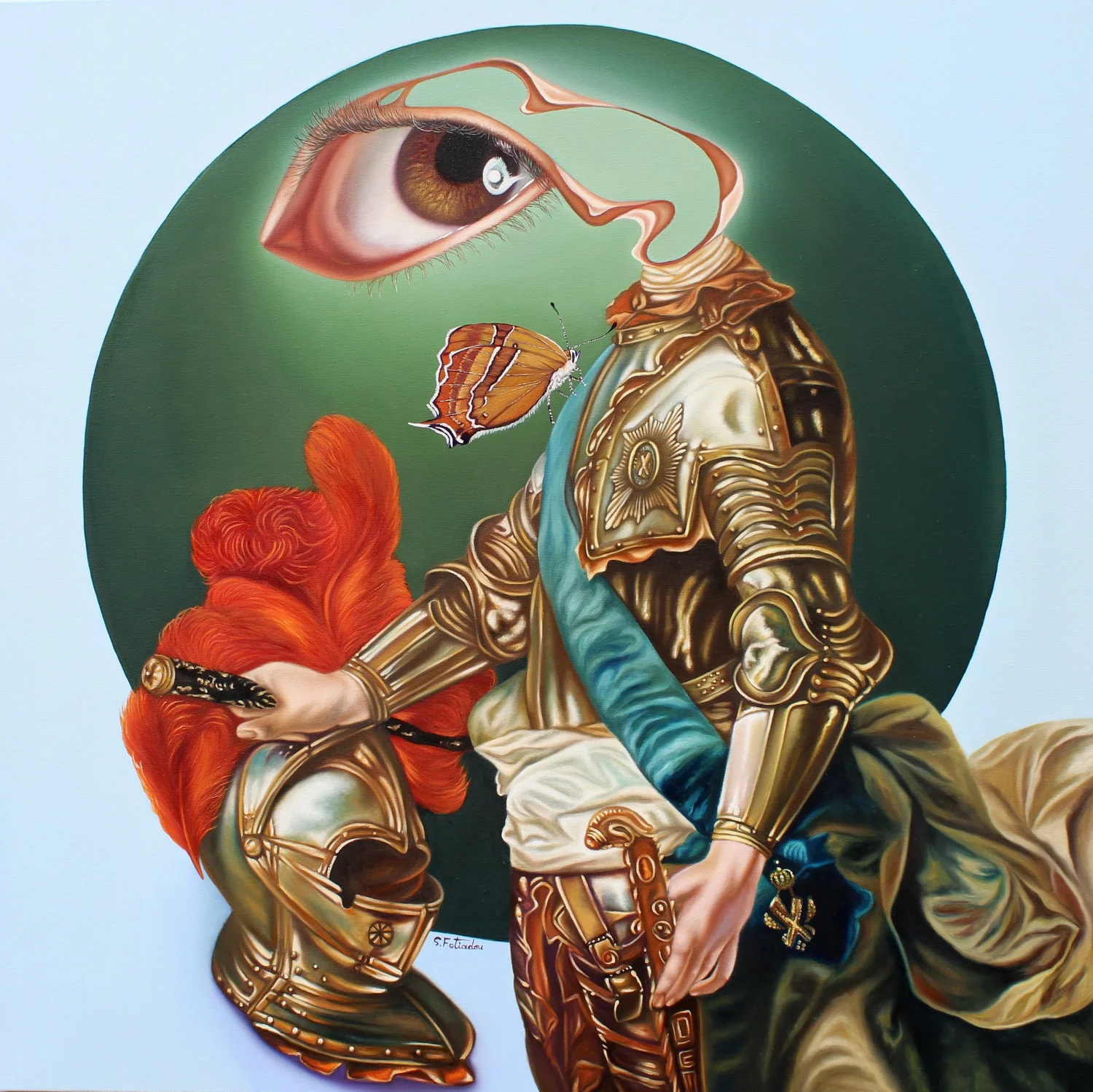
Destination
100x100cm, oil on canvas
Destination constitutes a visual act of re-signification of the historical image and the concept of power within the contemporary condition. Its point of departure is the portrait of Tsar Peter I (1717) by Jean-Marc Nattier, which functions not as a reference of faithful reproduction, but as an archival trace — a cultural artifact reactivated through the process of deconstruction. The replacement of the head with a floating eye introduces a gaze that no longer belongs to a subject, but operates as a mechanism of observation, memory, and control. It refers simultaneously to surveillance and consciousness, raising the question of knowledge without a bearer and vision without identity. The circular chromatic formation in the background functions as a conceptual space of transition — a site between past and future, where history ceases to be linear and is transformed into an open field of interpretation.Destination is situated within a visual practice that investigates the relationship between image, history, and power, calling into question the authority of representation. It is a work that does not represent history, but renegotiates it.